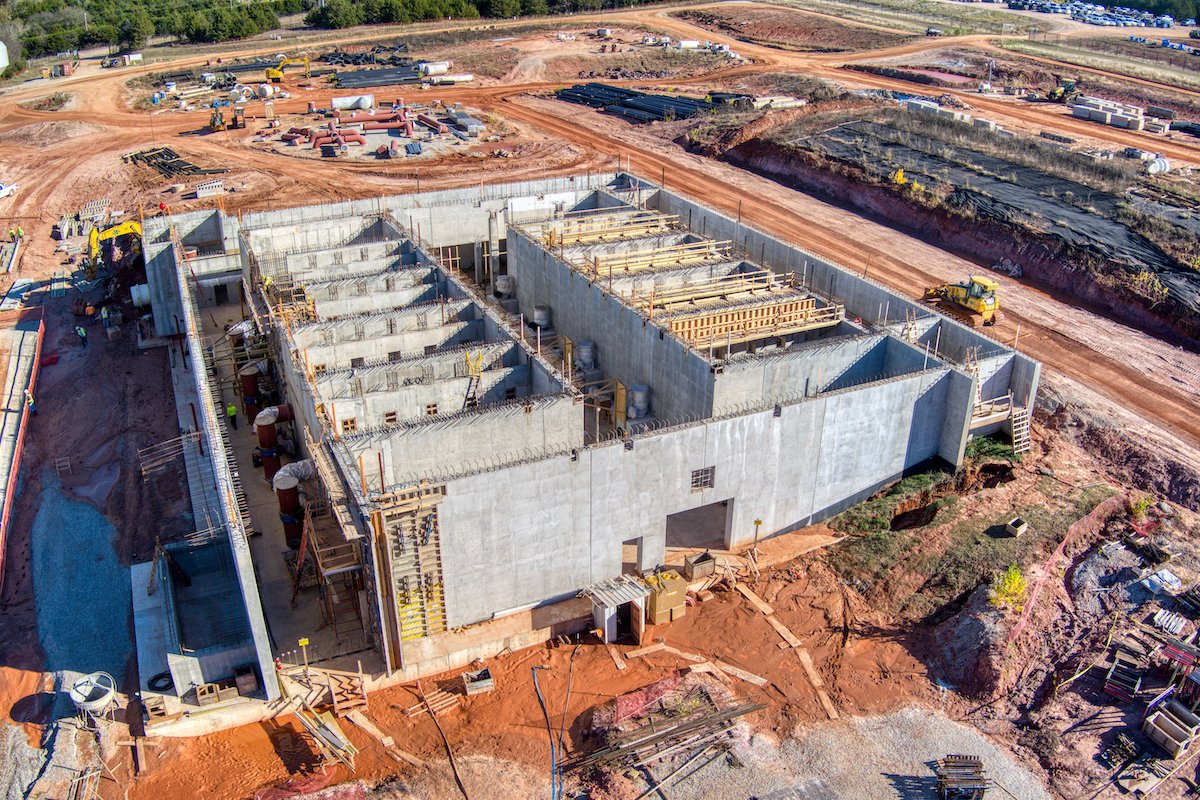
Drilled Pier Foundations for Oklahoma Hangars, Plants and Pole Structures
Drilled shafts and belled piers for Oklahoma structures: tall columns, crane rails, pole bases and pipe racks that need depth and resistance to tipping.
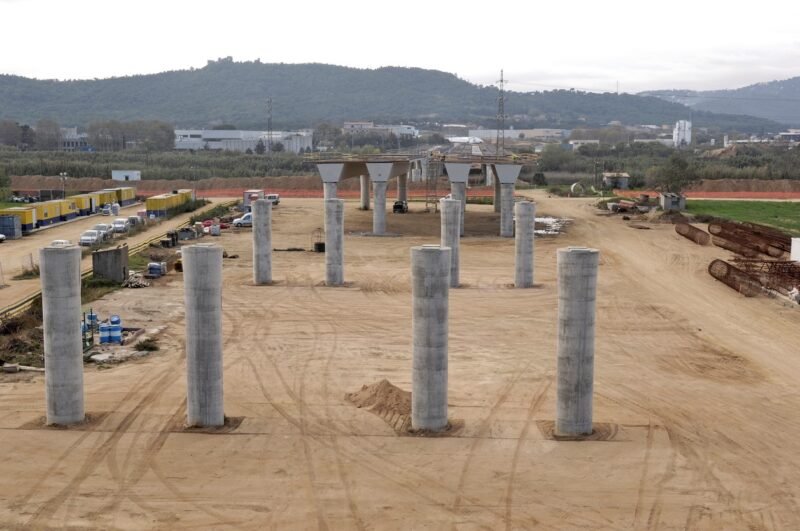
Hangar doors, crane columns and light poles all want the same thing: a shaft that does not move. A spread footing resists a column that pushes straight down. It does much less for a pole that wants to tip, a rack that sways with wind or a crane rail that pulls sideways when the bridge brakes. A drilled pier gets its strength from depth, from the soil along its sides and from a stiff concrete and steel body that works like a column set into the ground.
We drill and pour piers for industrial owners who have tall, heavily loaded or laterally loaded structures. A pier is made by drilling a round hole to the depth the engineer requires, cleaning it, setting a steel cage and filling the hole with concrete. Sometimes the base is belled, sometimes the shaft is socketed into rock, and sometimes casing or slurry holds the hole open through water or loose soil. Each choice affects cost, schedule and the risk of problems, and we explain them in plain terms before the rig arrives.
Where a broader look at foundation systems is needed, we cover driven piles, helical piers and augered methods in our page on deep foundations and piers. This page is about the drilled method.
What a drilled pier package involves
The scope begins with survey and utility clearance, followed by mobilizing a rig sized to the diameter and depth. We drill to the design elevation, check the bottom for cleanliness and bearing, place the reinforcing cage with spacers so it stays centered and pour concrete by a method suited to the hole: free fall in a dry hole, or tremie placement when water or slurry is present. Anchor bolts, embeds or sleeves are set at the top while the concrete is still workable, using templates so they land within tolerance.
Beyond the shaft itself, we build the tie-in: pier caps, grade beams, pedestals and base plates, and the backfill and finish grade around them. For pole bases we place the bolt cage and conduit stub-ups for yard lighting and electrical site work, so the pole, the conduit and the foundation arrive on schedule together.
Open shafts, spoil and slurry
An open pier hole is a hazard to people and equipment, and we treat it that way from the first minute. Holes are covered or fenced the moment the rig moves, cages are staged away from traffic and the swing radius of the rig is marked. Hoisting steel cages calls for rigging checked by a competent person, and crews do not work under suspended loads.
Spoil and slurry need a plan. Cuttings are hauled away or stockpiled away from the edge of the hole, and slurry is handled in tanks or pits, tested and disposed of according to the owner and the permit. Where the site is near a drainage way or the levee system, we place controls so that nothing washes toward water. Work near overhead power lines requires clearance distances and a spotter, and we confirm them every day because rigs move.
Floodplains, levees and rock in the ground
Piers fit many Oklahoma conditions. In Jenks, a Corps-built levee dates to 1948, and in 1986 the Corps released up to 300,000 cubic feet per second from Keystone Dam, leading to a mandatory evacuation. Sites near river levees often have alluvial soils and high water tables, and a drilled pier through those layers into firmer material is a common answer for structures that cannot afford to settle. We coordinate with the engineer and the levee authorities on any work near such embankments.
At the other end of the spectrum, Tahlequah is described as sitting in the foothills of the Ozark Mountains at an elevation of 814 feet, and sites in hilly country often put rock close to the surface. Rock sockets allow piers to take heavy loads on a small footprint, though they require heavier tooling. The geotechnical report tells us which kind of ground we have, and we match the drilling method to it.
Rigs, cages and concrete under our control
We schedule and supervise the drilling, the cage fabrication or placement, the concrete work and the top-of-pier details with managed subcontractors, so one team is responsible for the finished shaft. Controlling the sequence matters. A hole left open overnight in unstable soil can collapse, and a cage waiting for concrete can drift. We schedule so that each pier is drilled, inspected, reinforced and poured in a continuous flow.
Quality checks are part of the work. We measure the depth and diameter, verify the bottom, record concrete volumes against theoretical volume and take cylinders. Where the engineer requires integrity testing or load testing, we coordinate with the testing agency and build time for it into the schedule. Records go to the owner at turnover, which helps if anyone later questions a foundation.
Timing the rig and the steel
Pier work usually sits on the critical path, because steel and precast cannot start until foundations are done and cured. We plan the rig schedule against delivery of the next trade, build in time for weather, and look for places where parallel work can save days. A large building with many piers may call for two rigs, and the owner should decide early whether that cost is worth the time it saves.
Concrete supply is the usual constraint. Piers need a steady flow of concrete with a workable mix, and remote sites need a reliable plant and truck cycle. We confirm supply, mix design and backup plans before the first hole, and we coordinate with the steel erector or the structural steel erection team so bolts and plates fit when their crew arrives.
Structures that depend on piers
An aircraft hangar has long spans, tall doors and large lateral forces, and the foundations carry all of it. A large maintenance campus with a two-bay hangar of 130,000 square feet and 14 hangar bays in total, as the KC-46A depot at Tinker is described, shows the scale at which column foundations multiply. Owners in advanced manufacturing install piers under tall racks, process towers and crane-supported bays as well.
Pole structures, pipe racks, stack bases, conveyors, signs and fence posts for heavy security installations use the same method at smaller sizes. Our work on high-bay crane-ready buildings often includes drilled piers under the crane columns, where the loads are largest and the tolerance for movement is smallest.
Get the shafts priced with the soil report
Send us the geotechnical report and the column or pole schedule. We will recommend a method, price the work and tell you what to watch for in the ground.
Common Questions
How deep do drilled piers go?
The depth comes from the engineer and depends on the soil, the load and the pier diameter. Some piers are only a few feet deep for light poles, while others reach tens of feet for tall columns or heavy lateral loads. We drill to the specified elevation or to the required rock socket, and we log what we find so the engineer can confirm the design matches the ground.
What happens if water is in the hole?
We choose a method to handle it. Temporary casing can keep water out of the hole, a pump can remove small inflows, and tremie placement of concrete through a pipe from the bottom up displaces water without washing out the mix. For heavy flows, slurry methods keep the hole open. We plan this from the borings, which should show groundwater levels.
Are drilled piers better than driven piles?
Neither is better in every case. Drilled piers make little noise and vibration, handle large diameters and can be built into rock. Driven piles are fast, can be verified by driving records and suit sites with consistent bearing layers. The soil, the loads, the neighbors and the schedule decide, and we give owners a side-by-side comparison.
How long before steel can be erected on new piers?
It depends on concrete strength requirements. Piers often reach the strength needed for light loads within days, while full design strength takes longer. The engineer or the erection plan sets the minimum, and we use cylinder breaks to confirm it. We schedule the cure so the steel crew arrives to piers that are ready.
Can you drill near existing structures?
Yes, with care. We check for vibration limits, protect existing foundations and utilities and use methods that limit ground movement. Drilling is less disruptive than driving, which makes it a frequent choice for plant additions and tight sites. We agree on monitoring and stop-work triggers with the owner before work starts.