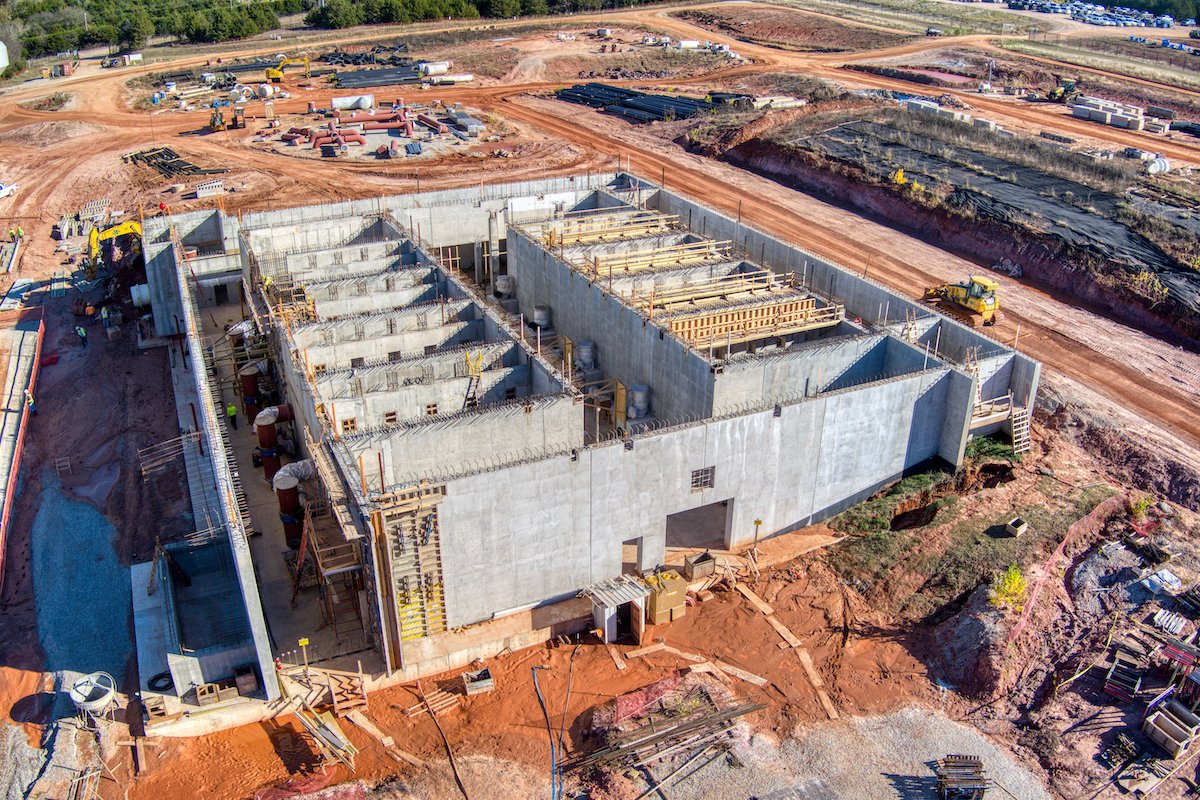
Industrial Construction in Oklahoma City
Ground-up warehouses, aerospace supplier buildings, truck courts and site utilities in Oklahoma City, planned around routes, codes and tornado season.

Truck routing decides more Oklahoma City industrial decisions than any other single factor, and it is where we begin when an operator calls about a new building or a yard. The John Kilpatrick Turnpike runs 31.0 miles with its entire route inside city limits, so a site near one of its interchanges can reach the north side, the west side and the south side without touching a downtown street. We build the distribution shells, the truck courts and the process buildings that sit on those routes, and we plan each one around how the trucks will actually arrive.
The same thinking applies to the other big corridor. The Crosstown section of I-40 was relocated a few blocks south and finished on February 17, 2012, with a design volume above 170,000 vehicles a day on at least ten lanes. That moved freight and left a different set of parcels near the interstate, and it is part of why sites on the south and west sides keep drawing warehouse and light manufacturing interest. For a buyer, the question is not whether the highway is close but whether the approach roads, the entrance geometry and the utilities will support a loaded trailer turning in at six in the morning.
We schedule and supervise the earthwork, the site utilities, the concrete and the structural work that make a parcel into a working facility, and we coordinate the remaining trades. On an Oklahoma City project that means a clear picture of the drainage path, the fire water supply and the permit review before a dozer starts, not after.
What we build inside the city limits
Our Oklahoma City work falls into three groups. The first is ground-up logistics space: warehouse shells and cross-dock buildings with heavy dock aprons and concrete truck courts. The second is manufacturing and maintenance space for aerospace and energy-sector suppliers, where the building is often a high-bay shell with overhead cranes, clean utility service and a floor that holds a precise tolerance. The third is the unglamorous but essential site package: grading, detention, site utilities and the yard lighting that lets a facility run a night shift.
A good example of how the market moves is the recent logistics activity at OKC Logistics Park, where a 300,000-square-foot multi-purpose distribution center was announced for SW 29th and Council with about $40 million in capital investment. We did not build it, but it tells an owner what the area expects from a new building: large floor plates, deep truck courts and quick turns at the dock. Those are the specifications we price and schedule against when we build comparable space for our own clients.
Codes and the city review
Oklahoma City lists the International Building Code, the National Electrical Code and the plumbing, mechanical and existing-building codes as its current adopted editions, with city supplements for commercial, fire, electrical and related work. The state has adopted newer editions, so the edition a particular permit falls under depends on the city's own adoption and the date of application. We confirm that with the Development Center before we finalize a drawing set, because a mismatch costs weeks.
Oklahoma does not require a state license for general contracting, but the trades that do need licenses, such as electrical, mechanical and plumbing, must be properly registered. We check the licenses of every trade on a job as a matter of routine. The practical effect for an owner is a cleaner submittal: the right stamps, the right contractors, and fewer comments to answer on the second review cycle.
Aerospace and military support work
The south side of the city is shaped by the air base next door. A $255 million, 845,000-square-foot military engines facility opened beside Tinker Air Force Base on October 1, 2024, and a $25 million, 130,000-square-foot expansion supporting the base was announced for September 17, 2026. The region around the base keeps producing work for suppliers: precision shops, parts storage, test cells and the office space that sits in front of them. We take on that work in the Will Rogers and Tinker area as well.
Supplier buildings of this kind share a few features. Floors are flat and often thick. Power is heavy and must be clean. Security separates the visitor entrance from the production floor, and the schedule is tied to a contract award rather than a calendar. We build with those constraints in mind and carry the long-lead items, such as switchgear and overhead cranes, on a procurement log from the first week.
Weather and weekly rhythm
Roughly 150 tornadoes have touched Oklahoma City limits in the city's recorded history, thirteen of them violent. We do not build in fear of that number, but it shapes how we schedule. Steel erection and tilt panel lifts are planned around the spring forecast, laydown yards are graded so loose material does not become debris, and we maintain a shelter and stand-down plan on every site. For finished buildings, we discuss roof and wall systems that match the exposure the owner wants to carry.
On the calendar side, the most sensitive time in central Oklahoma is the spring pour season, when rain and wind compete with schedule. We sequence deep foundations and slab work ahead of it where possible and keep a short list of backup tasks so crews never stand idle. Owners who need a firm date will hear about the weather margin we are building in, not discover it later.
How the rest of our work connects
Most Oklahoma City projects start with preconstruction services so the land, the utilities and the building can be priced together. When the owner wants one team accountable for drawings and construction, we offer industrial design-build. For operators in logistics, our logistics and distribution experience carries over directly, and manufacturers can see the parallel in our advanced manufacturing work.
If your project is on the other side of the metro, the same crews and the same way of planning apply in Edmond and Norman, and we regularly stage from one city to serve another when the schedule requires it.
Send us the site and the truck count
Tell us the parcel, the building size and the number of trucks you expect in a peak hour, and we will come back with a build sequence, the permit path through the city and the long-lead items to order first. If the site is next to a running operation, tell us that too, because it changes the whole plan.
Common Questions
Which city codes will apply to my building in Oklahoma City?
The city currently lists International Codes and the National Electrical Code with local supplements. Oklahoma has adopted newer editions at the state level, so the controlling edition depends on the city's adoption and the permit application date. We confirm it with the Development Center at the start of design.
How do you handle a build next to an operating plant?
We plan lockout, hot work, access and haul routes around what has to keep running. That means separate construction gates where possible, written work windows with the operations lead, and no tie-ins during production hours unless a shutdown is scheduled. The plan is shared with your safety lead before mobilization.
Can you build near Tinker Air Force Base?
We build for suppliers and operators in the surrounding area, and we work through the base-adjacent access and security conditions that apply. We do not suggest we have built for the base itself. If your site is next to the fence line, we will review height, lighting and traffic restrictions with you early.
What affects the cost of a distribution shell here more than anything else?
Site work and floor specification usually move the number most: how much fill the parcel needs, the size of the detention basin, and the flatness and thickness of the slab. Steel pricing and long-lead dock equipment come next. We price those separately so you can see which choices matter.
How early should I bring in a contractor?
Before you close on land if possible. Soils, utilities, floodplain and truck access are all things a builder can test in a few weeks, and each can change the value of a parcel by a wide margin. A short preconstruction engagement is usually the cheapest hedge you can buy.