About Industrial Contractors of Oklahoma
Industrial construction in communities across Oklahoma.
Industrial Construction Across Oklahoma
Industrial Contractors of Oklahoma builds and expands industrial facilities across the state, from ground-up plants on open land to process and manufacturing support work inside fences that stay in service. Most of what we do begins with one question: what has to keep running while we build? The answer sets our schedule, our access plan, our hot work rules and, more than anything, the order in which we sequence the job.
We are a contractor, not a brand exercise, so this page sticks to how we work and where we work. We do not list awards, headcounts or a project tally here, because none of those tell an owner whether a crew will show up prepared. What tells you that is the way we talk about lockout, permits, shutdown windows and containment before a contract is signed.
Working beside an operating plant
Oklahoma industry is a mix of refineries, pipelines, aerospace, tire and rubber, food processing, metals and a growing logistics base. Many of the people who call us manage a facility that cannot stop. A process unit has a turnaround calendar. A hangar line has aircraft that need to roll in and out. A distribution floor has trucks at the dock every hour of the day. Construction in those places is a coordination problem first and a building problem second.
That is why we are comfortable with phased work on an operating plant. We break a scope into zones, agree on barricades and laydown, and write down which utilities can be taken down and for how long. Lockout and tagout are handled with the owner's operations team, not around them. When a shutdown window is short, we pre-build and pre-fabricate everything we can outside the fence so the work inside the fence is assembly rather than invention.
We also talk about what happens when something goes wrong. Containment, spill response, emergency access for fire apparatus and a clear path for evacuation are covered at mobilization, not after the first incident.
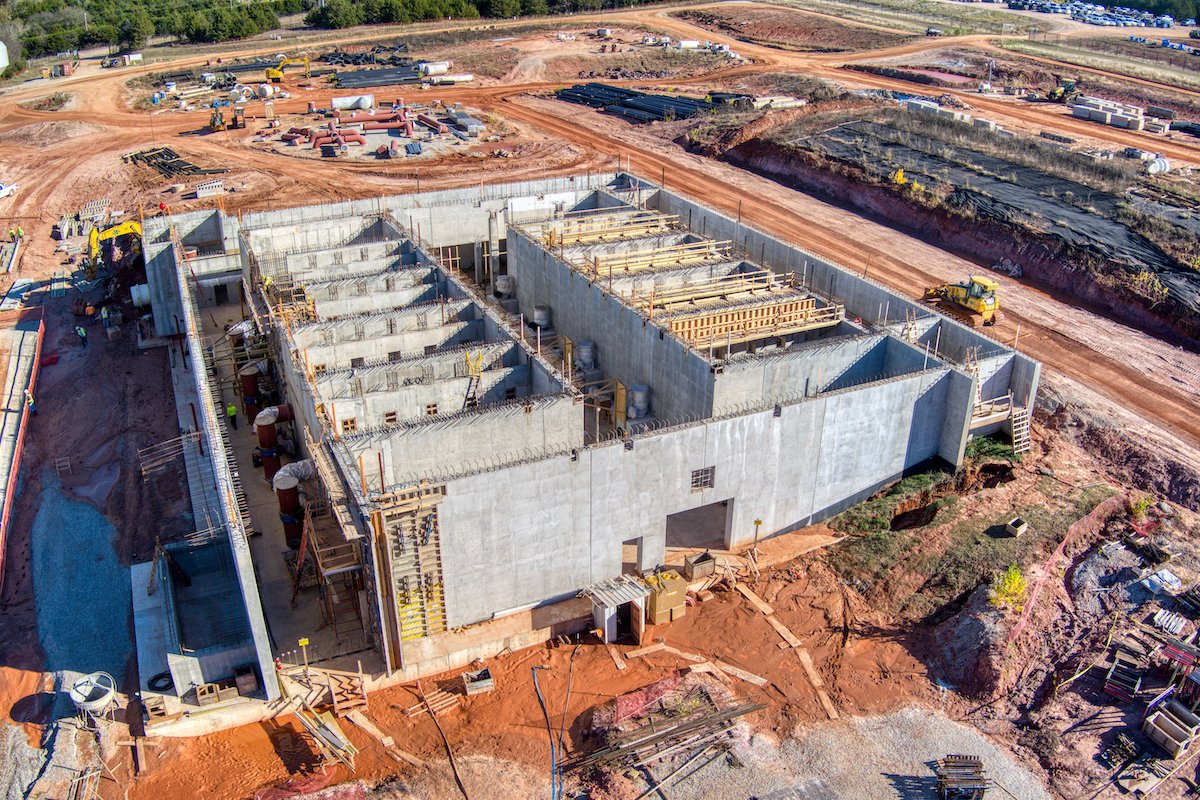
From dirt to a working site
Heavy site civil is where many industrial projects are won or lost. Before a wall goes up, the ground has to drain, carry loaded trucks, supply water for fire protection and take power underground. Oklahoma gives site crews real work on all of these. Red and clay soils change character with moisture, spring storms arrive fast, and the state records an average of nearly 60 tornadoes a year according to the National Weather Service in Norman. Drainage and detention are not afterthoughts for us. We design the grading plan around where water will actually go on a wet May afternoon.
Our civil scope covers clearing and mass grading, stormwater detention and drainage, site utilities, electrical duct banks, stabilized laydown and truck courts, dock aprons, yard lighting, fencing and security. Trailers are hard on pavement, so we watch subgrade and concrete thickness where they turn and park. heavy haul access roads get the same treatment, since a road that cannot carry a crane or an oversize load is a road that has to be built twice.
Fire protection deserves its own mention. fire water loops and hydrant systems are among the first underground systems we coordinate on a new plant, because the fire marshal, the insurer and the owner all have a stake in them and each one wants the layout settled early. We lay them out with future expansion in mind so a hydrant is not stranded behind a later dock.
Buildings, structure and foundations
On the vertical side, we build tilt-wall and pre-engineered metal buildings, structural steel frames, high-bay crane-ready halls, warehouse shells, distribution expansions, mezzanines and catwalks, and industrial office space inside the plant. Foundations are where heavy equipment gets its start, so we take drilled piers, equipment pads and industrial slabs seriously. A slab for a forklift fleet, a press or a rail-served dock has to be flat, reinforced and jointed for the load it will carry, and we talk through joint layout and curing with the owner before the first truck arrives.
The manufacturing plants we deliver tend to share a few traits. Clear heights are generous, floors are loaded, utilities are routed to equipment that may not be bought yet, and expansion is planned from day one. We plan for the next bay as well as the first.
We also take on specialty envelopes such as refrigerated and cold storage, pharmaceutical manufacturing support, data center support buildings and aircraft hangars. These carry tighter tolerances for insulation, vapor control, cleanliness or door clearances, and we match the crew and the submittals to the requirement instead of treating every shell the same.
How we plan before we build
Good industrial work is mostly decided before mobilization. Our preconstruction work covers budgeting against real quantities, constructability review of the drawings, long-lead procurement for switchgear, steel, overhead doors and process equipment, and a candid look at the permit path. Oklahoma sets minimum building codes statewide through the Uniform Building Code Commission, and the state has adopted newer International Codes, but each city adopts and enforces its own edition and amendments. Oklahoma City, Tulsa, Edmond and Norman still list editions, so we confirm the edition and any local amendments with the building department on every project instead of assuming.
The state also does not issue a general contractor license, though trade licenses and registrations apply to specific work. We treat that as a reason to be exact about who is performing each scope, how we manage each trade partner, and how those partners are vetted before they set foot on an operating site.
Where we build in Oklahoma
Our work follows the state's industrial map. In central Oklahoma, the Will Rogers Airport and Tinker area is home to a large aerospace and defense workforce and a dense supply chain, and the metro around Oklahoma City, Edmond, Norman, Moore and Midwest City supports warehouses, light manufacturing and distribution. Tinker Air Force Base alone covers nine square miles and more than 15 million square feet of buildings, which gives a sense of how much industrial space sits in that corridor.
In the northeast, Tulsa and its neighbors Broken Arrow, Owasso, Jenks, Bixby and Sand Springs carry a mix of manufacturing, energy and logistics. The Tulsa aerospace district is built around a large airline maintenance base and a long list of aviation suppliers. The Port of Catoosa is a 2,000-acre industrial park at the head of navigation on the McClellan-Kerr navigation system, with barge, rail and highway access in the same place. Further east, Pryor and the MidAmerica Industrial Park hold thousands of acres of industrial land with rail service on site. Each of these places comes with its own approval process, soil conditions and traffic patterns, and we plan for them separately.
The rest of the state matters just as much. We serve Bartlesville, Muskogee, McAlester, Stillwater, Enid, Ponca City, Lawton and Fort Sill, Ardmore, Durant, Ada, Altus, and the western corridor through Clinton, Weatherford, Elk City and Woodward, out to Guymon in the Panhandle. Three interstates, I-35, I-40 and I-44, cross Oklahoma and more than 2,600 miles of Class I rail run through it, which is part of why distribution and manufacturing keep choosing the state.
The industries we know
We build for owners in heavy industry, advanced manufacturing, food and beverage, automotive and electric vehicle supply chains, pharmaceutical and life sciences, cold storage, logistics and e-commerce fulfillment, data centers and utilities. Each sector has its own habits. Food plants care about washdown, sanitary finishes and drainage that actually drains. Metals and heavy industry need slabs and pads that handle impact and heat. Utilities and power work depends on clear lines of access, strict clearances and careful underground coordination. Oklahoma also produces more energy than it consumes, according to the Oklahoma Department of Commerce, so power and energy-linked industrial work shapes much of the demand we see.
Closeout and what comes after
A building is not finished when the last inspection passes. Commissioning, owner training, as-built records, warranty documents and a clean turnover list are part of the job. If an owner needs to expand, rework or modernize an older facility, we are glad to return and pick up from those records.
If you have a site, a shutdown window or a plant that needs room to grow, send us the drawings or just the problem. We will tell you what we would ask first, what we would price, and what we would want to see on site before committing to a schedule.
Common Questions
Do you work inside operating plants?
Yes. Phased construction on occupied and operating sites is a core part of our work. We agree on zones, access, lockout, hot work permits and shutdown windows with the owner before mobilizing, and we pre-build outside the fence wherever we can to shorten time inside it.
Which parts of Oklahoma do you serve?
We serve the state, including the Oklahoma City, Tulsa, southern, northeastern and western corridors, as well as the Panhandle. Our location pages list the markets in more detail, from Edmond and Norman to Ardmore, Enid, Lawton and Guymon.
Do you use trade partners?
Both, depending on the scope. We tell owners up front which vetted trade partners we manage for each scope, so there is no confusion about who is responsible for each part of the job.
Do you need a state general contractor license in Oklahoma?
The Oklahoma Construction Industries Board states that general contractors are not currently required to hold a state license for general contracting, though trade licenses and registrations apply to specific work. Cities set their own requirements and enforce their own code editions, so we confirm those with the local building department.
Can you handle both site civil and the building?
Yes. We take on grading, drainage, utilities, fire water, paving and concrete, along with the building shell, foundations, steel and interior buildouts, which keeps one team accountable for how the site and the building meet.
How early should we involve you in a project?
As early as possible. Budgeting, long-lead equipment, permit paths and shutdown planning all go better when we are at the table before the drawings are final.