Industrial and Heavy Site Construction in Tulsa
Industrial shells, data center support buildings and heavy site packages in Tulsa, planned around flood risk, road work and a changing code.
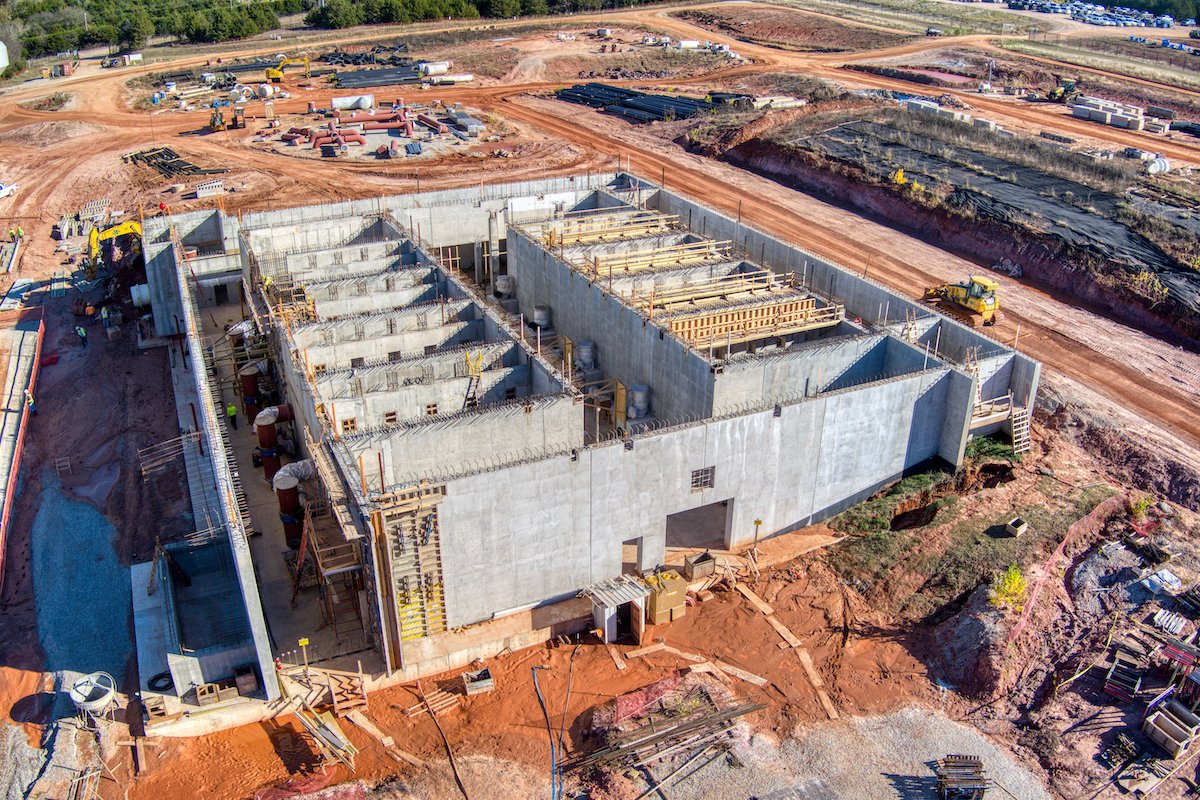
Data center owners, distributors and plant operators reading the Tulsa market need a contractor who can move a great deal of earth, set serious utilities and keep a build on schedule while the rest of the region competes for the same trades. That is the work we do. We build industrial shells, data center support buildings, truck courts, detention, fire water and electrical duct banks across Tulsa County, and we plan each project around the soil, the water and the roads that surround it.
The scale of announced work in the area is large. Meta announced on April 21, 2026 a $1 billion, 2-million-square-foot data center at the 2,000-acre Fair Oaks industrial innovation park in east Tulsa, expected to be operational in 2028 with more than 1,000 construction jobs at peak. Beale Infrastructure announced on October 30, 2025 a data center campus on unincorporated land north of Tulsa, which the Tulsa Regional Chamber said will reach $3 billion across multiple phases, with first-phase completion scheduled for summer 2027. These are owners' projects, not ours, and we cite them as evidence of how much heavy site work and supporting construction the area expects.
Smaller owners feel the effect in the trades market. Crews, concrete and electrical equipment are in demand, and a plan that starts procurement early has the best chance of holding its date.
Beyond data centers
Tulsa's industrial base is broader than one sector. An Oklahoma Department of Commerce article from December 2017 describes Cherokee Industrial Park on the north side as more than 1,300 acres near U.S. 75, U.S. 169 and the Tulsa Port of Catoosa, where a 1.3-million-square-foot distribution center created more than 1,000 full-time jobs. The combination of rail, highway and port access continues to attract logistics, manufacturing and energy-sector suppliers. The nearby submarkets, such as the Port of Catoosa area and Owasso, serve different needs.
For an owner, the question is which of those corridors suits the use. Distribution wants truck access and large floor plates. Manufacturing wants labor, power and sometimes rail. Data center support wants power, fiber and water. We match building to corridor and warn the owner when a parcel is a poor fit.
Tulsa codes and a coming change
The City of Tulsa Development Services plan review page states that Tulsa has adopted the ICC codes, including the International Building Code and International Existing Building Code, along with Tulsa's amendments, that Development Services issues permits inside city limits and that ordinance updates are in progress with an ordinance update pending. A building permitted before that date and one permitted after it may be reviewed under different editions.
That timing affects design. If a project's permit application might straddle the change, we ask the city which edition will apply and, if an owner wants to reduce risk, we speed the submittal. Parcels in unincorporated Tulsa County are reviewed by different authorities, so we confirm jurisdiction before the design starts. Our permitting and entitlements coordination service handles those questions.
Water is the first design constraint
The National Weather Service reports that the Memorial Day flood of May 26 to 27, 1984 killed 14 people and injured 288 in Tulsa, with $180 million in damages, of which Mingo Creek alone accounted for $125 million. The Oklahoma House reported on May 28, 2024 that the U.S. Army Corps of Engineers places the river levee system in Tulsa County in the top 5 percent most at risk for failure, with $50 million in state funding and $137.4 million in federal matching funds proposed for repairs.
For a builder, those facts translate into disciplined drainage and floodplain work. We read the flood maps, set finished floor elevations with margin, design detention that handles the design storm and verify the outfall. Where a site lies near creeks or levees, we involve the civil engineer early and keep records of every grading decision. The stormwater detention and drainage crews we coordinate handle that work.
Working around road closures
The Oklahoma Department of Transportation's Tulsa advisory as of early November 2026 lists a major I-44 and US-75 interchange improvement with ramp and street closures continuing through summer 2028. Contractors who ignore detours learn the hard way, so we plan deliveries by checking the advisory weekly, scheduling heavy loads outside peak hours and agreeing with suppliers on alternate routes.
Concrete pours, which cannot wait in traffic, are timed to arrive within the mix's working time, and we have backup plants identified. For large site packages, we stage materials at a laydown area and move them in short hauls.
Buildings we build in the Tulsa area
Common projects include data center support buildings, distribution centers, manufacturing plants and metal fabrication shops. Each has different needs: data center support buildings need security, power and cooling infrastructure; distribution centers need dock capacity and truck courts; and fabrication shops need cranes, heavy slabs and ventilation.
The EF2 tornado that touched down in Tulsa just after 1 a.m. on August 6, 2017 near 36th Street and Harvard Avenue is a reminder to design with wind in mind, and we discuss roof and wall connections with owners as a matter of course.
Services behind Tulsa projects
Many Tulsa projects begin with site clearing and mass grading and then move into electrical duct bank and utility work. Owners in the sector can read about our approach to data center construction.
Test your Tulsa site before you commit
Send us the parcel, the building and the date you need power, water and trucks. We will check floodplain, access, utilities and permit path, then return a site plan and sequence you can use with your lender and your board.
Common Questions
Which code edition applies to a Tulsa permit?
Tulsa has adopted the ICC codes with its amendments, and the city says ordinance updates are pending. We ask the city which edition will govern your application and plan the submittal date accordingly.
How do you handle flood risk on a Tulsa site?
We review floodplain maps, set floor elevations with margin, design detention for the required storm and check the downstream outfall. Where levees or creeks are nearby, we involve the civil engineer early and document each grading decision.
Will road work affect my deliveries?
Likely, yes. ODOT lists a major I-44 and US-75 interchange project with closures through summer 2028. We check the advisory weekly, set alternate routes with suppliers and schedule oversize loads outside peak hours.
Can you support a data center campus?
We build support buildings, site packages, duct banks and utilities for owners and their design teams. We do not claim any relationship to announced campuses; we describe the work we can perform for private owners in that market.
What is the best way to start?
With the site. A short study of soils, floodplain, utilities and access can change the price and schedule of a project, and it costs far less than discovering the same facts after closing on the land.