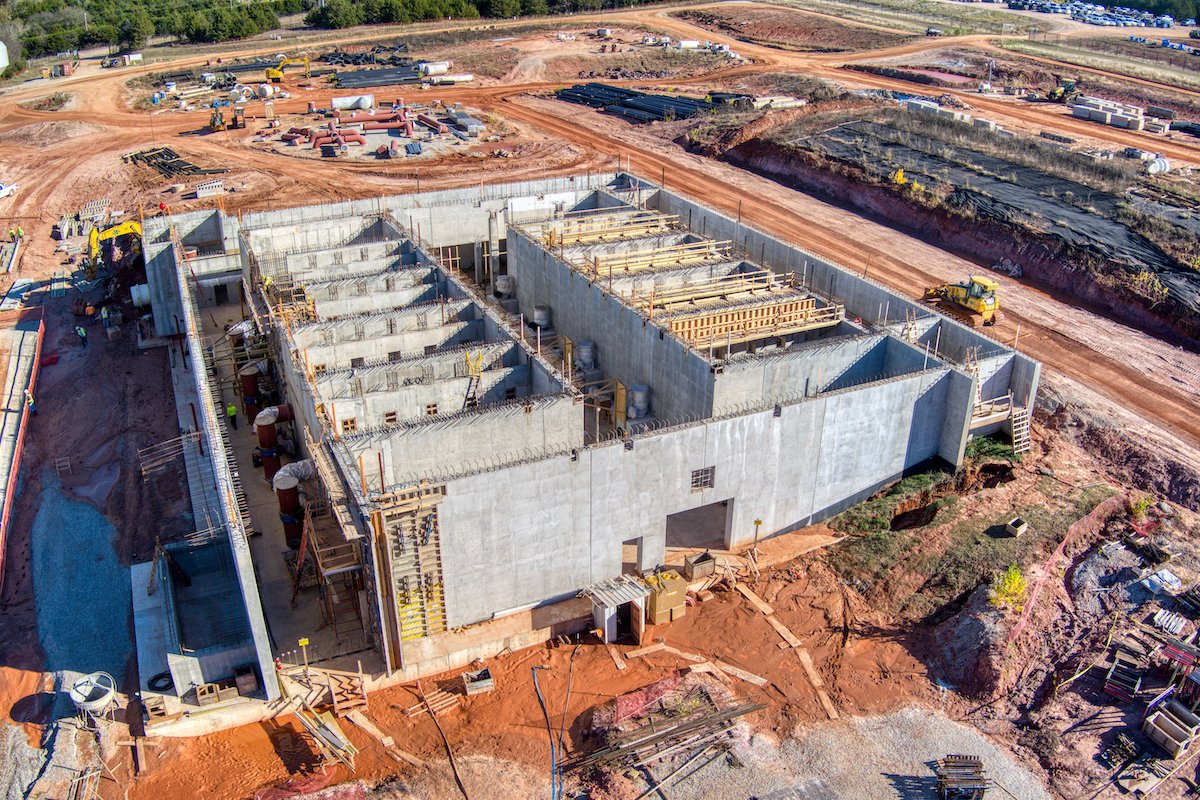
Electrical Duct Bank and Underground Work for Oklahoma Plants
Concrete-encased electrical duct banks, manholes, conduit and underground power routes for Oklahoma industrial plants, built to the engineer and the utility.
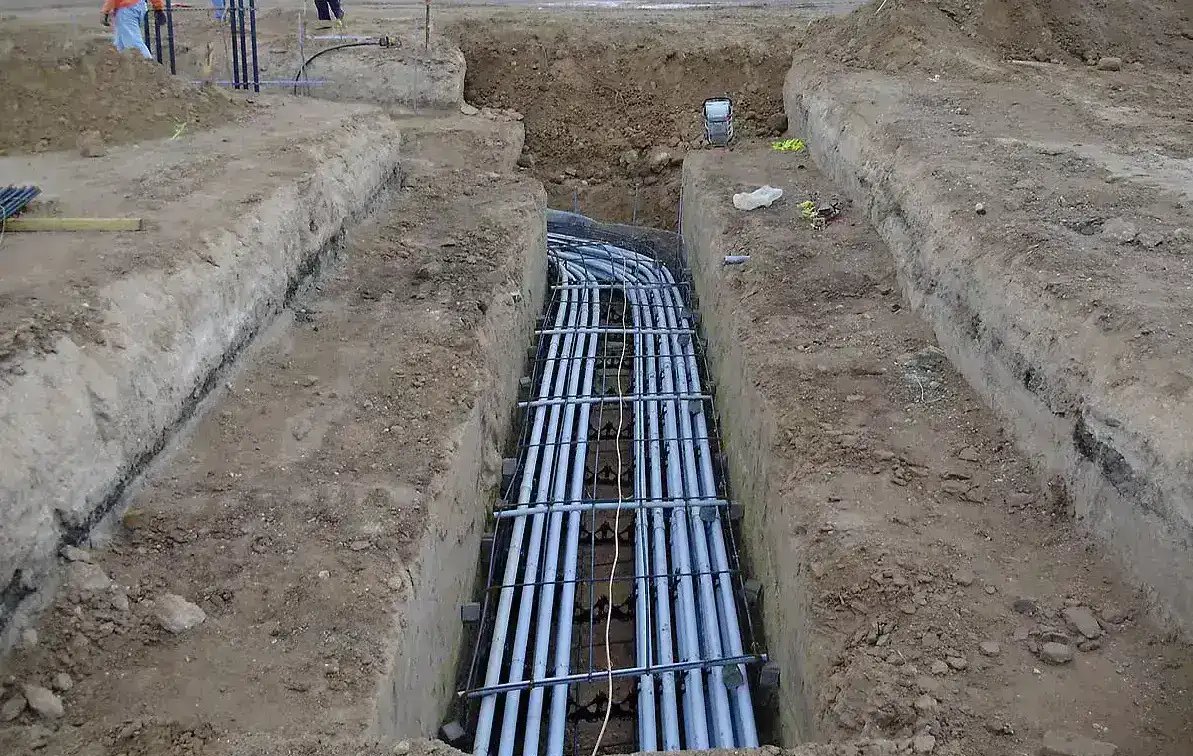
Under every large plant runs a set of concrete-encased conduits that no one sees and everyone depends on. They carry utility power from the point of service to the main switchgear, feed motors and process equipment across the yard, connect lighting and controls and give the owner room to add circuits later. A duct bank built carelessly shows up years afterward as a cracked conduit, a flooded manhole or a pull that cannot be made. We build them to last the life of the plant.
Our underground electrical work includes duct banks with spacers and reinforced concrete encasement, direct-buried conduit, manholes and handholes, transformer pads, pull boxes, grounding and the coordination with the utility that sets how power reaches the property. We work with the owner's electrical contractor, who installs the cable and equipment, and with the utility, which sets its own requirements for service entrance and metering.
The point of doing the underground work carefully is simple: it is the one part of the electrical system that cannot be changed easily later. Once the slab and the paving are placed, a missing conduit becomes a saw cut, a core drill or a long trench through finished pavement.
Electrical code and utility requirements
Electrical work in Oklahoma follows the National Electrical Code edition adopted by the state and enforced by each city. The Oklahoma Uniform Building Code Commission adopted the NEC, while a number of cities still list earlier editions, so we confirm which one governs before drawings are issued. The edition affects burial depths, conduit fill, grounding and working clearances.
The serving utility has its own standards for service routes, transformer pads, conduit sizes and metering. Some require the contractor to install conduit and pads to the utility's drawing, while others install their own. We obtain the standards early and build to them, and we coordinate any utility outage and energizing date with the electrical contractor.
Power is driving Oklahoma projects
Electricity is one reason industrial buyers look at Oklahoma. The state reports that renewables generate 47 percent of its electricity and that energy costs run 17 percent below the national average. A development company and a power firm announced an on-site power project for a new industrial park in Chickasha, intended to supply sectors such as data centers, critical minerals processing and advanced manufacturing. A $1 billion data center of two million square feet was announced for east Tulsa with more than 1,000 construction jobs at peak.
Those figures show the load that is coming to the state's industrial sites. Large loads need large underground paths: wide duct banks, multiple spare conduits and manholes sized for heavy cable. We build with that in mind, and we recommend spare ways wherever the owner may expand. The cost of an extra row of conduit in an open trench is small beside the cost of finding room for it after the yard is paved and the plant is running.
What we build and how it is laid out
A typical duct bank starts with trench excavation to the engineer's depth and width, followed by a compacted bedding, plastic or steel conduit set on spacers to hold exact separation, reinforcing steel where specified and a pour of concrete or flowable fill that fully surrounds the conduits. Color or dye in the concrete marks the bank for future excavators. Manholes are cast in place or set precast, with duct entries sealed and ladders or steps as specified.
We also pull mandrels through every run to check that the conduit is clear, leave pull tape in place and cap the ends. Each run is labeled and surveyed so the plant has an accurate record of what is below the surface. Depth and offset dimensions go in the as-built drawings that we hand over at closeout.
Why we manage the underground closely
Underground electrical work depends on accurate layout, good concrete and compaction. We schedule and supervise the trenching, the forming, the concrete and the backfill because those are the pieces where timing and quality matter and where coordination with other trades is hardest. The electrical contractor focuses on cable, terminations and equipment.
Our trade partners also build transformer and equipment pads, light pole bases and the conduit stub-ups to the building at the same time. That coordination avoids the common situation where a pad is poured a few feet from where the equipment lands. It is one of those details that costs little to get right and a lot to repair.
What goes wrong, and how we prevent it
The most common problems are conduit crushed by heavy equipment before the encasement cures, bends that exceed the pulling limits of the cable, water entering through open ends and duct banks built through an area later used for a rail or drainage structure. We protect fresh work with plates and traffic control, review bends and offsets with the electrical contractor and cap every conduit end.
Coordination with other underground work is the other issue. Water, gas, storm sewer and fire lines cross duct banks, and clearance rules apply. We lay everything out on a single plan with the site utilities package before any trench opens, and we keep the plan current as the work proceeds. On sites with yard lighting and electrical site work, we place conduits for poles and cameras before paving.
Plan the underground paths early
Send us the one-line diagram, the site plan and the utility's service requirements. We will lay out the duct bank routes, price the work and fit it into the utility and paving schedule. We can combine this with ground-up industrial construction for a complete site.
Common Questions
How many spare conduits should we install?
More than seems necessary. Adding conduit later through finished pavement is far more expensive than adding it during construction. Owners commonly ask for a healthy share of spare capacity on main routes, and the electrical engineer sets the actual number.
Is concrete encasement always required?
Not always. The code and the engineer determine whether direct-buried conduit, a concrete-encased bank or flowable fill is required based on voltage, location and traffic loading. Under roads and heavy truck areas, encasement is common.
Who coordinates with the utility?
We coordinate our part, including trench and pad schedules, and the electrical contractor and owner handle the engineering and application. The earlier the utility gets a complete application, the earlier it can schedule its own work.
Can you work around existing underground power?
Yes, with careful locating, potholing and hand digging. In operating plants we plan outages and temporary power with the owner. See our phased construction approach for how we do.
How does your work relate to data center projects?
Data center campuses use very large duct banks and several redundant routes to the building. We build those paths for owners in the data center market and can match the extra reviews and documentation such projects need.