Site Utilities Package for Oklahoma Industrial Projects
Water, sanitary sewer, gas, storm and fire line installation for Oklahoma industrial sites, coordinated with providers and built ahead of the foundations.
Water is the first question a plant asks about a rural Oklahoma site. In the Panhandle, the Ogallala Aquifer is the water source for Guymon, and news reports in 2024 described levels dropping and the city pumping 5.4 million gallons on one day, about 92 percent of its pumping capacity. The city has since leased rights to 640 acres of water for a new project through 2080, with first water expected in October 2026. A plant that needs process water has to understand where its supply actually comes from before it buys the land.
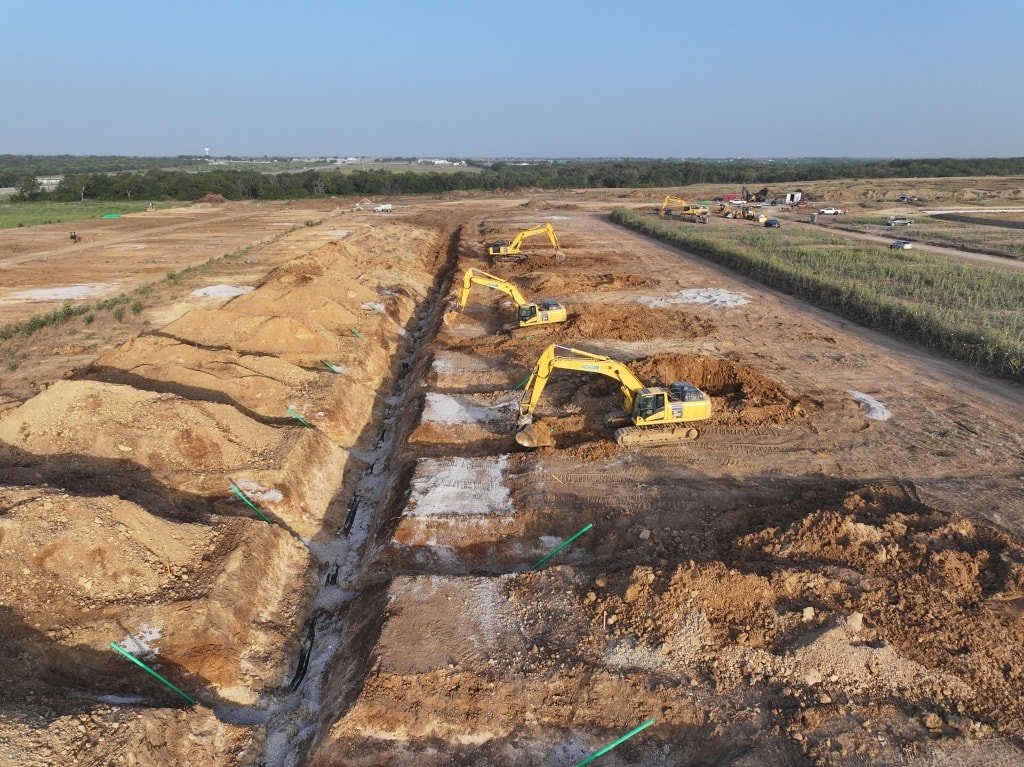
Our site utilities package covers everything that has to be in the ground or on a pole to make the plant work: domestic and process water, fire service lines, sanitary sewer, storm sewer, natural gas, electric service, telecommunications and the connections to each provider's system. We manage the underground work and coordinate the rest, so that utilities reach the building at the right place, depth and time.
Utilities are the least visible and most schedule-critical part of a site. A trench left open too long blocks the building, a line placed at the wrong depth costs money to relocate, and a service that arrives late delays startup.
Utility supply varies sharply across the state
Not every site has the same support. Some parks offer a full set of utilities at the property line. Others are rural and need extensions, wells, lift stations or private treatment. At MidAmerica Industrial Park, a January 2021 article on the park's own site notes custom electricity from the Grand River Dam Authority across a 9,000-acre campus, an example of how a large park can structure its own power supply.
The state also reports that Oklahoma produces more energy than it consumes and that energy costs run below the national average. That is good for plants with heavy electric or gas loads, but it still depends on a provider's lines, capacity and construction schedule. We ask each provider early for a will-serve letter and a written schedule, and we make those schedules part of ours.
What the package includes
The package normally includes water mains and services with meters and backflow preventers, fire water loop and hydrant work where the project needs them, sanitary sewer with manholes and a connection to the public system or a private treatment structure, storm sewer tied to the drainage plan and natural gas services to the point the utility specifies. It may also include conduit for electric and communications service, which we coordinate with the electrical duct bank and underground work.
We build to the engineer's plans and the provider's standards, which vary. Pipe material, bedding, depth, tracer wire, testing and inspection all follow the owner of the line. We pressure test, flush and disinfect water lines, test sewer for leakage and deflection and record every inspection.
Approvals and providers
Each utility has its own approvals. Cities approve water and sewer taps, the gas company approves the service route, the electric provider approves service design and the fire marshal approves fire lines and hydrants. Some connections need payment of tap fees or construction by the provider's own crew. We map every approval and every fee at the start, so none appears late.
The Oklahoma Water Resources Board also lists water use permits and a pending permit dashboard, which matters when a plant plans to use a well. We help the owner identify whether a new well or an extension is the right approach and who has to sign off. This ties into our permitting coordination work.
Conditions that change the price
The largest factors are distance to existing mains, depth, soil, rock, groundwater and road crossings. A line that must cross a state highway or a rail line needs a bore and a permit, not an open trench, and both add time. We identify crossings in the first week and give the owner an early estimate of the lead time.
Existing utilities are the other risk. Most industrial sites have lines that are not on any drawing, and old plants have more. We locate before digging, pothole at crossings and keep our records current. The as-built drawings we hand over show where every line actually is, with depths and tie dimensions.
Sequencing underground work
Utilities go in after mass grading and before foundations and paving, but they do not all move at the same pace. We build the deepest lines first, because they need the widest trench and the most shoring, then work up through shallower lines and conduits. Trenches are backfilled and compacted in lifts so they do not settle under slabs and pavement.
We keep the site open for the work that follows. If the building crew needs to start a pier or a footing in one corner, we finish that corner's utilities first. A good utility schedule is built around the next trade, not around the pipe.
Work that depends on utilities
Utilities feed almost everything else on the site. Stormwater detention and drainage needs storm sewer and outfalls, truck courts and trailer yards need inlets and conduit for lighting, and the building needs services stubbed into the right locations. We lay the work out together so one trench serves more than one purpose where possible.
For owners in food and beverage and other water-intensive industries, we also coordinate wastewater pretreatment and discharge permits with the owner's engineer, because a plant's waste stream can set its sewer requirements.
Put the lines in the right place the first time
Share the site plan, the utility letters and the building program. We will review the routes, flag the long-lead approvals and price the package. If the site is already graded, we can start ground-up construction with the utilities.
Common Questions
How do we know if the site has enough water?
Ask the provider for a will-serve letter that states the capacity, pressure and any limits, and ask your engineer to check it against your peak demand. In areas with declining aquifers, ask also about long-term supply. We help the owner frame these questions during preconstruction.
Who pays for utility extensions?
It depends on the provider, the distance and the agreement. Some cities pay for extensions that serve several users, while others charge the developer. We get quotes and fee schedules early so the budget includes them.
Can the utilities be installed before the building permit?
Often, if the city issues a site or utility permit separately. This can recover weeks. We confirm with the building department what is allowed in advance.
How are underground lines tested?
Water mains are pressure tested and disinfected, sewer lines are tested for leakage and deflection, and gas lines are tested to the utility's standard. We keep the test records with the as-builts.
What happens if we hit an unknown utility?
We stop, protect it, notify the owner and the owner of the line and work out a solution. Locating and potholing in advance makes this rare, but plants with long histories always carry risk.