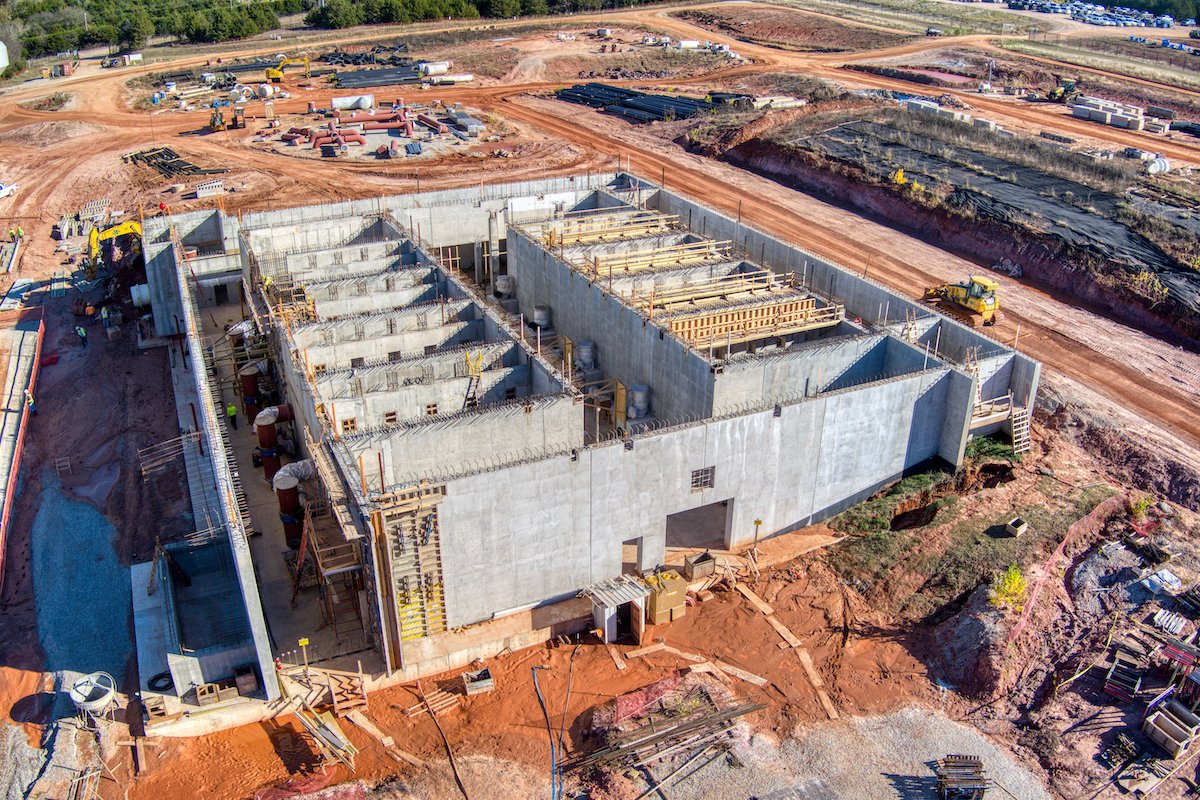
Industrial Park Site Work and Plant Construction in Chickasha
Industrial lots, power-ready sites and rail-served buildings in Chickasha, planned around I-44, US 81, the airport and a growing industrial park.
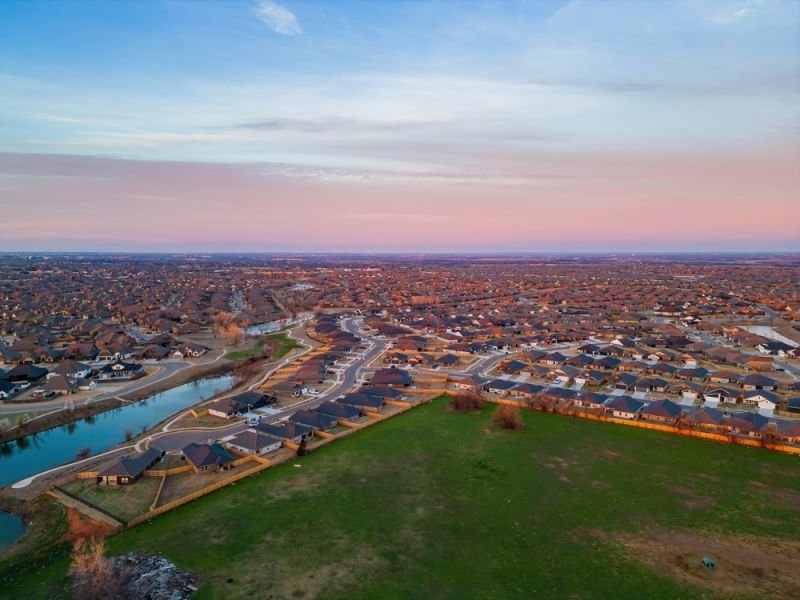
Fifty industrial lots of two to ten acres each is a lot of dirt to prepare, and a Chickasha owner picking one of them needs a contractor who can price the roads, utilities, drainage and building as a single program. A March 18, 2025 report said the Chickasha Municipal Airport Authority sold 320 acres of undeveloped land next to the airport for $1,578,000, with a first phase of 50 such lots planned. We build for buyers who want to turn a bare lot into a working facility without managing a dozen separate bids.
The pattern for a lot like that is familiar. Grading comes first, then the utility trenches, then the pad, the building and the paving. Between each step sits a permit, an inspection or a delivery that can stall everything behind it. We keep a single schedule that shows those dependencies and update it as soon as one moves, so owners know when to schedule equipment, hiring and a first shipment.
Chickasha also draws attention from a different kind of buyer. A June 6, 2025 Oklahoma Department of Commerce release called a new industrial park project the largest single private investment in the city's history, with a joint venture planning on-site power for sectors such as data centers, critical minerals processing and advanced manufacturing. We are not part of that project, but it shows the scale of site and power work that serious industrial users are weighing in Grady County.
Power, rail and highways around the industrial park
The Greater Oklahoma City Chamber describes a 240-acre industrial park with air access in Chickasha, located on Interstate 44 at the intersection of US Highways 81 and 62, with rail service four times daily through two Class I railroads. That is a short sentence with a lot of consequences for a builder. Rail service means track and ties to maintain or extend, interstate access means heavy trucks, and a nearby airport means height limits and lighting to respect.
Interstate 44, the H. E. Bailey Turnpike, passes through the southeastern side of the city with exits 80 and 83, and US 81 runs through the city center. We plan truck routes with both in mind, because a driver who comes off the turnpike has a different approach than one who comes up from the south. Our rail spur site improvements work applies when a lot needs track, and our logistics and distribution page explains how those users judge a site.
Sequencing a program of lots
When a park releases lots in phases, the first owner often pays for infrastructure that later owners will share. We help buyers understand that before they sign. If the road, drainage and utilities are already in place, our work starts at the lot line. If they are not, we price the missing pieces as separate line items so you can negotiate with the seller or the authority from facts.
For owners who want a standard building repeated across several lots, programmatic multi-site rollouts shows how we reuse drawings, buying power and crews to cut time. Every lot still gets its own geotechnical report and site plan, but the building package stays the same, which keeps cost predictable.
Permits, platting and the airport next door
Chickasha Municipal Airport has runway 18/36 listed at 5,101 feet long and 100 feet wide with a concrete surface, plus two turf runways, according to the Oklahoma Aerospace Commission. Anyone building a tall structure, a crane pad or a lighted yard near an airport should ask early whether federal notice or local height rules apply. We raise the question during permitting and entitlements coordination, not at the inspection stage.
Beyond airspace, the usual list applies: platting, building permit, fire marshal review, stormwater controls and utility connection approvals. We prepare submittals, track comments and respond quickly, because a missed comment is the most common reason a good schedule slips. We do not assume a code edition for your project; we confirm the adopted codes with the local building official at the start.
The services that matter on a bare lot
A bare lot rarely needs only a building. It needs stormwater detention and drainage that meets local rules without eating half the buildable area, a fire water loop and hydrants if the building size or use requires it, and a durable truck court for the vehicles that will serve it.
We scope these as one civil package so the drainage design shapes the grading and the paving, not the other way around. When owners buy the site first and design the building later, we often catch conflicts at this stage, such as a detention pond placed where an expansion should go. Fixing that on paper costs almost nothing.
How we handle power-dependent users
The 2025 joint venture announcement mentioned on-site power for energy-hungry sectors, and it points to a real question every large user should ask: where will the electricity come from, and when? We cannot answer it for a utility, but we can build around the answer. That means electrical duct banks, equipment pads, transformer foundations and yard lighting designed to match the utility's schedule instead of guessing at it.
See electrical duct bank and underground work for how we route and protect conduit, and data centers for the questions we ask owners in that sector. For any user, we ask for the load letter early, because power is usually the longest lead item on a modern site.
Storm planning in Grady County
The National Weather Service Norman office lists an EF4 tornado on May 24, 2011 that traveled from 2 S Chickasha to southwest Oklahoma City, killing 1 and injuring 48, and an F3 tornado on May 3, 1999 that ended 2.5 WNW of downtown Chickasha and injured 4. Those are records, and we cite them only because they belong in a sensible planning conversation for a plant that employs people.
We review shelter options, safe-room placement and building connections with every owner, and we write the construction safety plan with the same seriousness. Owners comparing Chickasha with Duncan or Ardmore should expect the same storm discussion in each.
Bring us the lot and the load list
Send the plat, the target building size and the power and truck requirements. We will return a clear scope, a schedule and a price for your Chickasha site.
Common Questions
Can you build on the new airport-area lots?
Yes. We would start with the plat, the covenants and the utility availability for the specific lot. Then we price the pad, building, drainage and paving together. Because the lots are in a planned park, you should also confirm any shared infrastructure costs before closing on the land.
Do you handle rail-served buildings?
We build the site and building side: grading, track bed preparation where required, dock layout and the floor and aprons that meet the track. The standards of the railroad govern the track work itself, and we coordinate with them from the start. Rail service can add months, so we raise it early in planning.
What does nearby airport activity mean for construction?
It can mean height limits, lighting requirements and notice rules for tall equipment such as cranes. We check these during permitting so that the schedule does not depend on a late surprise. For ordinary one- or two-story industrial buildings the impact is usually modest, but it should still be verified.
How do you handle large power needs?
We ask the owner for the utility load letter and the planned energization date at the start. Then we design duct banks, pads and yard lighting to fit that timeline. If the utility date is late, we help the owner decide whether to phase the building or temporary power.
Can you work in phases as lots become available?
Yes. We can build the first building and leave room, utilities and sleeves for the second. A phased plan costs a little more in the first phase but often saves the cost of tearing out finished work later.