Rail Spur Site Improvements for Oklahoma Industrial Properties
Site work for Oklahoma rail spurs: subgrade, ballast prep, crossings, loading pads and drainage built to railroad standards for plants and distribution sites.
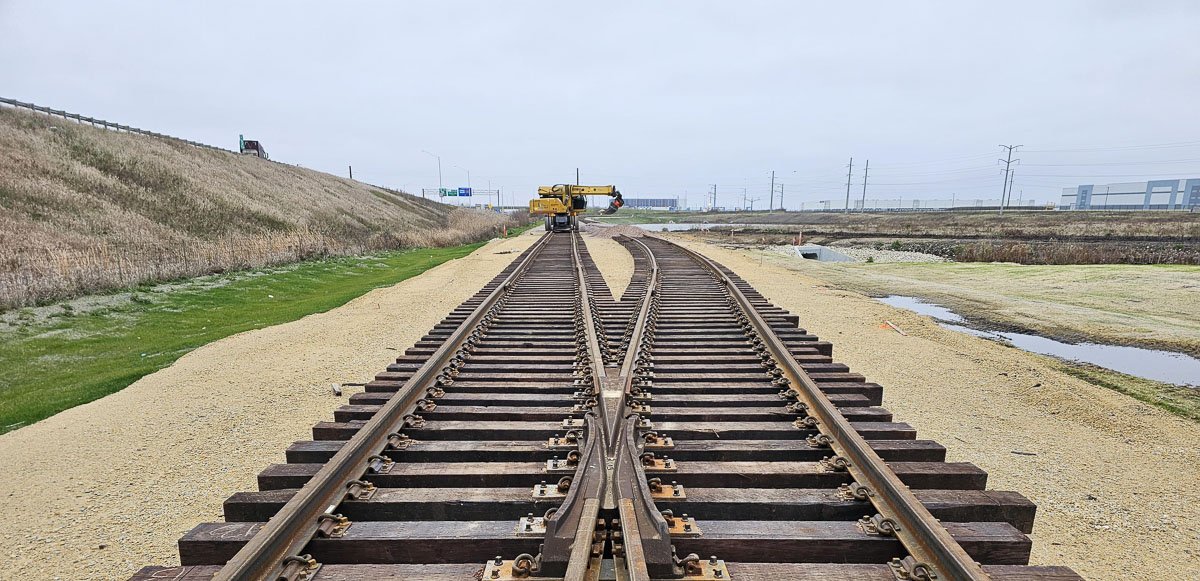
Track, once built, ties an owner to a railroad for years. The spur has to meet the serving railroad standards for geometry, drainage, clearances and crossings, it has to be approved before it is placed, and it has to carry loaded cars without settling. Most of the cost of a good spur is not steel and ties. It is the ground work underneath: the grading, the subgrade, the ballast section, the drainage and the paved areas where cars are loaded and unloaded.
We build the site side of rail spurs for industrial owners across Oklahoma. We prepare the corridor, place and compact the track subgrade, build the drainage, construct grade crossings and concrete loading pads, and coordinate with the track contractor and the railroad so the pieces line up. The track itself is laid by a rail contractor approved by the serving railroad, and we schedule our work around theirs.
A spur is a long-term decision, and the cheapest time to get it right is before the first cut is made. We spend time at the front end walking the corridor, studying the turnout location and talking with the railroad, because a spur that does not line up with the mainline connection costs far more to repair than to build correctly.
Sequencing a spur from the turnout outward
We begin at the turnout, because that is where the railroad has the least flexibility. Once the connection point, the lead length and the track centers are set, the rest of the spur is fitted around them: the storage tracks, the loading positions, the grade crossings and the drainage. We survey the full alignment, check vertical curves against the design, and place a staking plan that the track contractor can trust.
Subgrade work follows. Rail loads are concentrated, and soft or wet ground causes track to settle and go out of line. We proof roll, treat or replace weak soil, build up to the design elevation with compacted layers, and shape the ditches so water leaves the track bed. Ballast and sub-ballast are placed in the sequence the track contractor requires. We stay available during track installation to handle surprises, because a spur always has a few.
Where rail matters most in the state
Oklahoma has more than 2,600 miles of Class I rail operated by BNSF, Union Pacific and CPKC, according to the state Department of Commerce, and industrial users tie into it in a wide range of ways. McAlester Army Ammunition Plant lists 223 miles of railroad inside its fence, which shows how rail can function as the internal circulatory system of a large site. A 15-acre industrial site near Shawnee is described as bordered on its east end by a BNSF rail spur and zoned for medium industrial use, the kind of ready-made connection that cuts months from a project.
Public money is also going into track. Leaders in the Ardmore area reported securing $47 million from the state PREP fund for industrial airpark infrastructure upgrades, with railway construction scheduled to begin in summer 2024 and a later report describing the expansion as under construction. Owners considering a location near a developing industrial rail corridor should ask what track is planned and who will maintain it.
Working around live track
Every task near an active railroad has its own safety rules. Railroads require contractor orientation, protective insurance, flagging and, in some cases, track and time permits before equipment can cross or work within a set distance of the rails. We carry the training and coordinate flagging, and we schedule work so that cars are not trapped or locked out unexpectedly.
On an operating plant, a spur often runs close to process areas, storage and people. We establish a work zone, control access with barriers and signs, keep equipment off the track and coordinate with the plant on when cars can be switched. For customers handling hazardous materials, the layout of the loading area, containment and fire access is reviewed with the plant safety team before the first shovel goes in.
Railroad approvals and local permits
An industry track agreement or similar document comes first. It sets out who owns what, who maintains what and what standards apply, and it typically requires the railroad to review plans. We help owners assemble the submission: survey, track plan, grading and drainage, crossing details and clearance diagrams. Review times vary, so we keep the permit track and the construction track moving in parallel.
Local permits are separate. Grading, floodplain, stormwater and street crossings all come under city or county rules, and the state sets minimum building codes that apply to the structures around the spur. Cities adopt their own editions, so we confirm requirements with the local building department. A spur that crosses a public road also needs coordination with the road authority on warning devices and signals.
What changes the price of a spur
Length and turnout count are the starting points. A single short stub is far cheaper than a looped track with several turnouts. The ground is next: wet or soft sites cost more to prepare. After that come crossings, which can be expensive because of signals, panels and approvals, and drainage, which must handle both track bed and surrounding pavement.
Owners often forget the paved areas around the track. Transload pads, truck access, containment slabs and lighting are all part of making a spur usable, and they connect to our truck courts and trailer yards and to our heavy haul access roads. We price those areas along with the track so the budget reflects the whole facility.
Work that goes with a spur
A spur seldom stands alone. It connects to an unloading area, a storage building, a rail-served warehouse or a processing line. A distribution site on a spur often becomes the heart of a logistics and distribution operation, and a food or beverage plant on a spur may need washdown paving and containment around the unloading points, which suits owners in food and beverage.
We can also build the site utilities, fencing and lighting that serve a rail yard, and we can handle the building shell on the same schedule, which helps owners that want track and building ready at the same time.
Start with the connection to the main line
Share the property boundary, the railroad and the products you plan to ship. We will walk the corridor, outline the site work and give you a clear picture of cost and schedule.
Common Questions
Do you lay the rail itself?
We build the site work and coordinate with a rail contractor approved by the serving railroad, who lays the track, ties, turnouts and switches. This is typical because railroads set standards for who may do track work on or connected to their lines. We handle the grading, subgrade, drainage, crossings and paved areas, and we keep our schedule tied to theirs.
How long does it take to get railroad approval?
It varies with the railroad, the location and how complete the submission is. A clean package with survey, track plan and drainage can move more quickly than an incomplete one. We encourage owners to open conversations with the railroad early, even before the site is purchased, and we prepare the technical documents so there are fewer rounds of comment.
What is the biggest cause of trouble on a new spur?
Poor subgrade and drainage. Track that settles or goes out of line after a few months of loaded cars is usually sitting on wet or poorly compacted ground. Spending more on subgrade treatment and ditches at the start costs less than correcting track later, and we recommend testing before design is final.
Can a spur be added to an existing plant?
Yes, and it often is. The challenge is fitting track geometry into an already built site, with buildings, utilities, roads and fire lanes in the way. We study the site, check clearances and find the layout that does the least damage to operations. Sometimes a shorter spur with a transload pad serves better than a full length track.
Does a spur change the building code or fire requirements?
The spur itself is mostly a railroad matter, but the structures and operations around it must satisfy the adopted building and fire codes and the local fire marshal. If hazardous materials are handled at the track, containment, fire access and spill control are part of the review. We confirm requirements with the city before drawings are final.