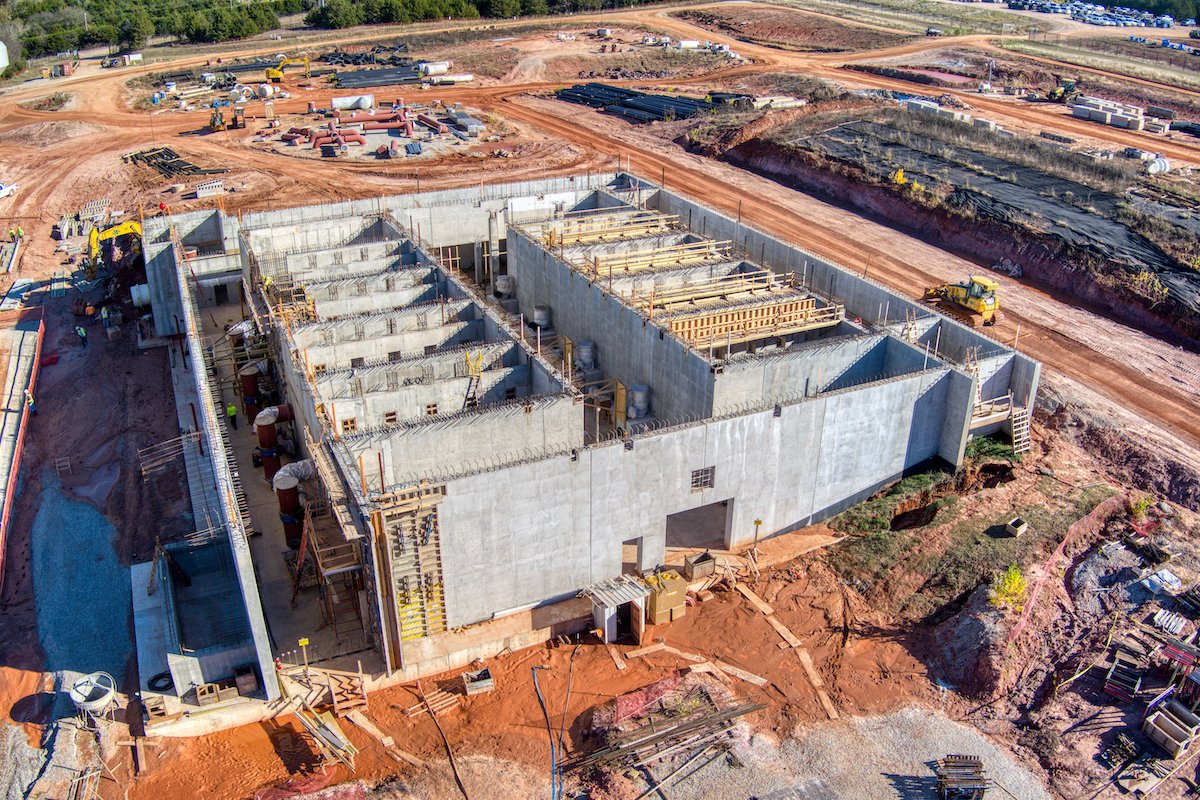
Heavy Haul Access Roads for Oklahoma Industrial and Energy Sites
Access roads built for oversized and overweight loads in Oklahoma: turning paths, pavement sections, culverts and bridge-free routes to plants and energy sites.
A turbine blade on a trailer needs more road than most plant entrances provide. So does a pressure vessel on a multi-axle platform, a transformer headed for a new substation, or a precast panel that will be lifted by a crane too large to move on public pavement. The road from the highway to the pad is often the first thing that decides whether a heavy load arrives on time, and it is rarely drawn with that load in mind.
We build heavy haul access roads for industrial and energy owners who need to bring very heavy or very long pieces to a site and do it more than once. The work covers the route study, the subgrade, the pavement section, the shoulders, the culverts and drainage, the turning radii and the connection to the public road. We build to the load, not to the typical truck, and we put that load in writing before design is final.
Many of these roads begin as construction roads and end as permanent plant roads. When that is the plan, we build the permanent section the first time, so the road that survives the heavy hauls is also the one the plant will use for years.
Loads that follow Oklahoma energy and freight
The state generates a lot of its own power from wind, and wind projects are a good test of any haul road. Federal energy data lists the Boiling Springs wind farm in Woodward County at 148.4 MW and Persimmon Creek Wind Farm 1 in the same county at 198.6 MW, and the planned Weatherford wind energy park in Custer County was described as reaching as many as 98 turbines on more than 5,000 acres. Every turbine needs a tower, a nacelle, blades and crane components moved on roads that were laid out for farm traffic. Owners in utilities and power know the pattern, and we plan around it.
Freight terminals add their own heavy hauls. The Tulsa Port of Catoosa, according to reports, added a 720-foot dock in 2016 that accommodates a rail line and multiple cranes, and heavy cargo moving off that kind of dock heads for plants within the region on trucks that exceed ordinary limits. The same applies to equipment moving toward Woodward and other rural counties where the last mile is often a county road.
Permits, routes and the people who must agree
Oversize and overweight loads need state permits, and the permit follows a specific route. We help owners and haulers walk the route in advance, looking for low utility lines, narrow bridges, tight corners, soft shoulders and rail crossings. Findings go back to the transport planner and the owner, who may decide to widen a corner, rebuild a shoulder or relocate a sign. County and city agencies often have their own requirements for work in the right of way, including driveway permits, culvert approvals and traffic control plans, and we prepare those applications.
The owner should also expect conversations with utilities. Overhead lines that clear an ordinary truck may not clear a tall load, and moving a line takes lead time. The earlier the route is studied, the more choices the owner has, and the fewer of them cost schedule.
What we manage on a haul road
Our trade partners clear the corridor, shape the roadbed, place and compact the base, build the pavement and install the pipe, headwalls and ditches that carry water away. We place stabilized subgrade, geogrid or deeper base where the soil requires it, and we use concrete at spots where steel tracks, outriggers or tight turning would tear up asphalt. Where a road crosses a creek or drainage way, we size culverts for the flow and for the load above them.
Because we also perform grading and site clearing and mass grading, the road is built to the same survey as the pad it serves, which avoids the common problem of a heavy road arriving ten feet from where the pad actually ended up. Surveying is done with GPS and checked against the engineer of record before pavement starts.
Building the road before the load date
A haul road should be done before the first oversized delivery, not after it. We build backward from the delivery date, adding time for compaction testing, curing of any concrete and the drying of subgrade after rain. Oklahoma has long dry stretches but also heavy spring rain, and a road built or tested in a wet week can fail under its first heavy load. We hold the road to its tests rather than to the calendar.
Where loads will come in waves, we schedule maintenance between them: regrading, replacing stone at stress points, repairing shoulders and checking culverts. For owners with multiple loads over months, a standing maintenance plan costs less than rebuilding. On sites that also need a staging area, we coordinate with our stabilized laydown yards work so the road and the yard are one connected system.
Design questions to settle early
The load decides the road. Axle weights, overall length, width, ground clearance and turning behavior are all needed before design starts. Owners sometimes learn the real figures only when the haul company bids, so we ask for preliminary numbers early and expect them to change. Pavement thickness, subgrade treatment and the turning radius at each corner are the main quantities that follow.
Drainage is the second question. A heavy road with poor drainage becomes a rutted road in one wet season. We design side ditches, crossings and cross-slope to move water away quickly, and we plan for the hard rains that come in spring. The third question is future use. If a spur to the rail spur site is coming, the road should line up with it, and if the plant may double in size, the road should be able to take a second lane. Owners in metals and heavy industry raise this most often.
Tell us what has to arrive
Send the heaviest load, the route and the delivery date. We will study the corridor, price the road and tell you what it needs before the first transport permit is filed.
Common Questions
How is a heavy haul road different from a normal gravel access road?
It is designed around axle loads and turning paths rather than around ordinary truck traffic. The subgrade is stabilized or thicker, the stone or pavement is built to carry concentrated weight, and the corners are wider than a typical entrance would need. Culverts and bridges along the route are checked for the load as well. A normal gravel road may carry a few trucks a day and still fail under one oversize delivery.
Who is responsible for permits for the oversized loads themselves?
The hauler usually holds the transport permit, but the owner and the contractor feed the route information. We help by reviewing the route, identifying constraints and preparing right-of-way or driveway permits for work at the site. If the route needs a utility line moved or a corner widened, that is coordinated before the permit is requested.
Can the same road serve construction and plant operations afterward?
Yes, and it is often the cheapest plan if the permanent section is built at the start. We recommend building the road to the design needed for later operations, with temporary measures such as extra stone or mats only at spots that will not be permanent. A road built twice costs more than a road built once.
What happens to a haul road after heavy rain?
Rain softens subgrade and can pump fines through a thin base. We build with drainage in mind, check ditches and culverts after storms and hold heavy loads until the road has been inspected. For rural sites with long haul distances, we sometimes schedule the heaviest deliveries for the drier parts of the year.
How much room does a long load need at a corner?
More than most plans show. A long trailer swings wide at the inside of a turn and sweeps across the shoulder at the outside, so the corner needs a generous inside radius and firm ground beyond the edge of pavement. We lay out corners with turn templates from the hauler and adjust until the path fits, then build the widened area to the same standard as the road.