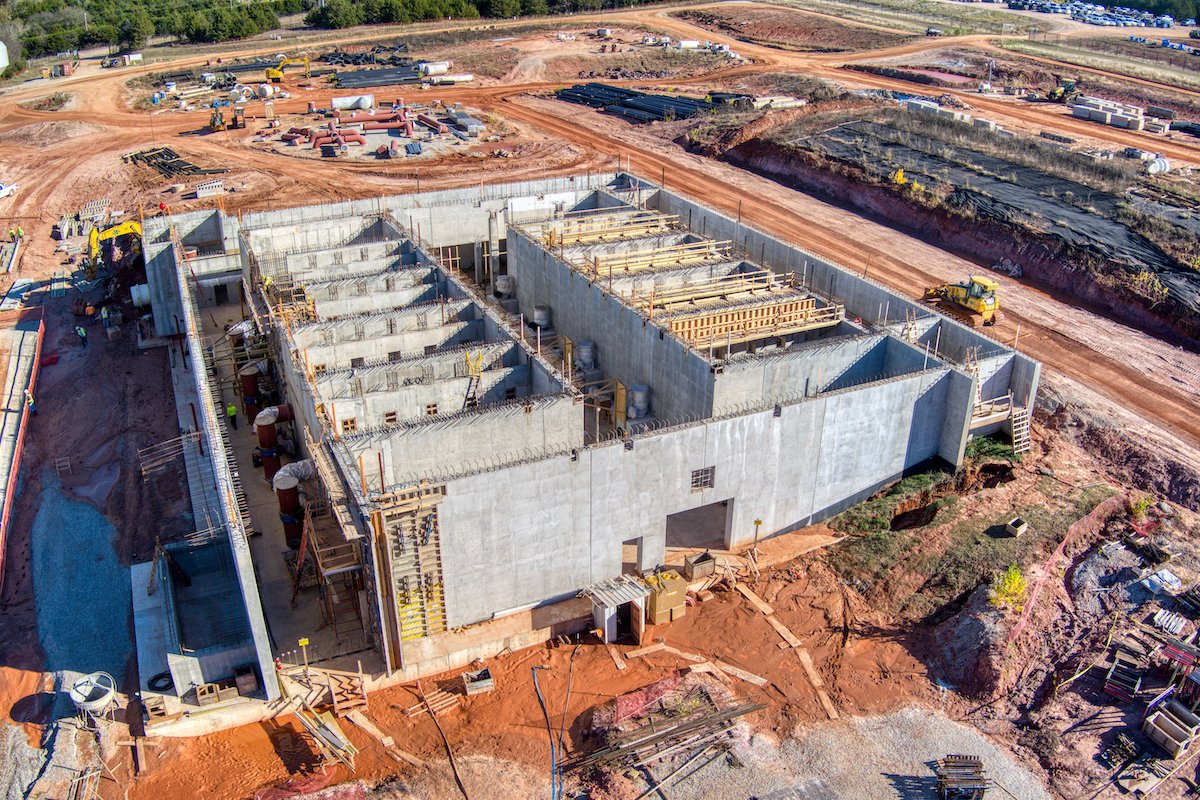
Plant Expansions Beside Live Operations in Sallisaw
Plant owners in Sallisaw get expansions planned around running equipment, with lockout, hot work and outage windows settled before any ground is opened.
Plant owners who need more floor, another process line or a new utility corridor in Sallisaw rarely get to stop production while the work goes in. Our job is to build beside running equipment without changing what the plant ships. We schedule and supervise the concrete, steel, mechanical and electrical trade partners, and we settle lockout, hot work and access with the owner's safety staff before anyone opens ground.
The town has useful logistics for that kind of project. Interstate 40 crosses Sallisaw, with US 59 and US 64 serving as its main city streets, so heavy loads can reach a plant gate from the interstate without crossing neighborhoods. Two railroads meet here, one running east and west and the other north and south, which matters to owners who move bulk material by rail and to any expansion that has to stay clear of a spur.
Manufacturing in town is also changing hands and adding space. A report dated December 31, 2025 covered the grand opening of the Sallisaw plant of Millison Casting Technology after it bought SLPT Global Pump Group. Cast-metal and pump operations like that tend to need new handling bays and heavy foundations, and the same planning carries over to refinery and pipeline-adjacent owners, where product lines add one more layer of care.
Sequencing deliveries around a running plant
On an operating site the delivery calendar is part of the safety plan. We agree with the plant on which gates trucks may use, which hours are quiet enough for crane picks and which days are off limits because of product shipments. Steel, rebar and precast arrive in a planned order so the laydown area never blocks a fire lane.
The municipal airport has a paved runway just over 4,000 feet long and no control tower. That suits small aircraft bringing a specialist or an urgent part, but anything oversize still comes by road, so we book permits and escorts early and tell the plant when a load will pass the gate.
Planning the tie-in before the first pour
Most of the risk in an expansion sits at the tie-in, where new piping, power or structure meets something that is already live. We walk that point with the owner's operators and maintenance planners before design is final, and we ask which line can be isolated, for how long and by whom.
From that walk we write a sequence in plain steps: what is built ahead of time away from the unit, what waits for a planned outage and what the fallback is if the window closes early. Owners get the sequence in writing, so a shift supervisor can read it and know what to expect on any day. We update it weekly and after every change to the outage plan, and we post the current version at the site gate for the trade partners.
What an expansion beside live equipment includes
Typical scope starts with survey and utility location, then excavation, equipment pads and foundations, structural steel and slab work, followed by mechanical, electrical and controls trades. We coordinate each trade partner, hold the progress meetings and inspect the work against the drawings before it is covered.
Because the plant keeps running, we add temporary measures that a vacant site would not need: barricades and spotters at active routes, dust and noise control near occupied rooms and clear marking of lines that must not be disturbed.
Buildings added to existing plant footprints
Expansions here usually take the form of a new production bay, a warehouse addition, a maintenance shop or a pad-mounted equipment enclosure. A manufacturing plant addition has to match the floor elevations, crane rails and door heights of the original building, so we confirm existing dimensions in the field instead of trusting old drawings.
Where a new building will sit close to a live one, we plan clearances, fire separation and drainage together so the addition does not change how the old building performs.
Services that support the expansion
Long-lead equipment decides many schedules, so we offer long-lead procurement management to track fabrication and delivery dates against the outage. When a plant needs more fire protection for the added area, we plan the fire water loop and hydrant work in the same sequence as the building.
Both services share a principle: the earlier the owner sees a date that might slip, the more options remain. We report float and slippage every week, in numbers the plant's planners can load into their own outage schedule.
Reaching Sallisaw from the interstate and nearby towns
We reach Sallisaw sites from the interstate corridor and coordinate with trade partners based in nearby towns. For work that draws on specialty fabricators or labor from the region, our pages for Muskogee and Tahlequah describe how we handle projects in those markets.
Distance matters on an outage, so we stage materials near the site ahead of time and keep a short list of local suppliers for the items that always seem to run short, such as gaskets, fittings and consumable rigging.
Permits and reviews for in-plant work
Work inside an operating plant still goes through the local building department for permits, and the plant's own standards often go further than the minimum. We obtain the permits, submit the structural and fire protection documents and keep inspection records organized for the owner.
Hot work, confined space entry and lockout permits belong to the owner's program, and we follow them exactly. A project calendar that lists permit and inspection dates beside the construction milestones prevents surprises late in the job.
Owners we plan for in this market
Metal fabrication, casting and pump operations are the closest match to what the area already supports, and our metals and heavy industry experience applies directly to foundations, crane bays and heat-affected areas. Owners with power or pipeline assets can also look to our utilities and power work, where outage windows set the pace.
Each of these owners wants the same thing: new capacity delivered without a missed shipment.
Send us the plant, the tie-in points and the outage dates
Share the unit, the operating constraints and the dates you have to meet. We will return a sequence, a scope and a price for your Sallisaw expansion.
Common Questions
Can you build while the plant is running?
Yes, when the plan separates new work from live equipment. We agree on barricades, access routes and quiet hours with the plant, and we keep the tie-ins for planned outages. The owner's operators stay in control of what is isolated and when it is released.
How do you handle lockout and hot work?
The plant's permit program governs both, and we follow it step by step. Our supervisors attend the pre-shift briefings, check that trade partners hold the right permits and stop work when conditions change. Nothing starts without a signed permit.
How early should we involve a contractor?
As soon as the expansion is a real option. Early involvement lets us review tie-in points, long-lead equipment and outage dates before they are fixed. Owners often save more by adjusting the sequence than by changing the design.
What affects the cost of an expansion beside live operations?
Access restrictions, outage length, long-lead equipment and the amount of temporary protection drive the price more than floor area does. We list each of those assumptions in the proposal so the owner can see where money goes.