Port, Rail and Process Plant Construction in Muskogee
Process-plant pads, rail-served buildings and port-area site work in Muskogee, planned around the river, flood history and existing manufacturing.
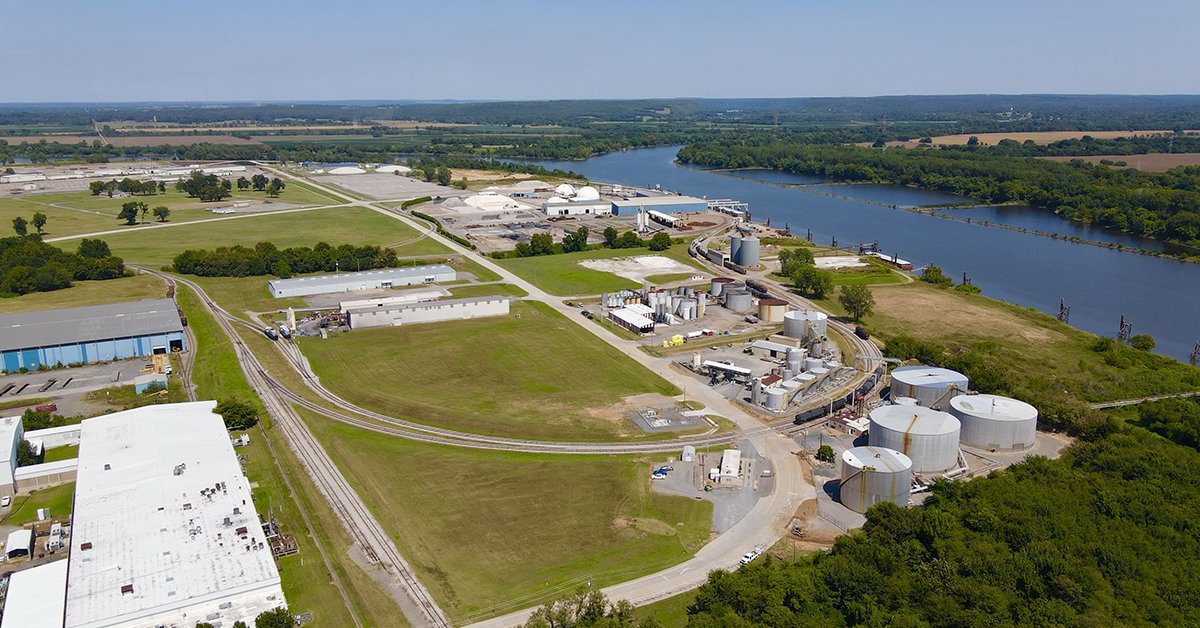
Process equipment, rail connections and floodplain elevations all land on the same drawing in Muskogee, and a contractor who has to reconcile them is working in familiar territory for us. Port Muskogee describes a 450-acre intermodal transportation complex on the McClellan-Kerr navigation system, with 3,000 feet of navigable waterfront, a 9-foot channel depth and Foreign Trade Zone 164. For a manufacturer, that package of river, rail and road is the reason to look at the city, and the building work is what turns the land into a plant.
The manufacturing base is broad. The Oklahoma Department of Commerce reported on August 31, 2026 that a glass container plant in Muskogee, long established there, has approximately 200 full-time employees and is among the top five industrial employers in the region. Wikipedia lists a 2.9-million-square-foot paper products plant with about 800 workers as the city's largest employer. A 2022 announcement described a $27 million expansion by an air systems manufacturer, with 80 new jobs and a new manufacturing plant. We cite these as signs of the market, not as projects of ours.
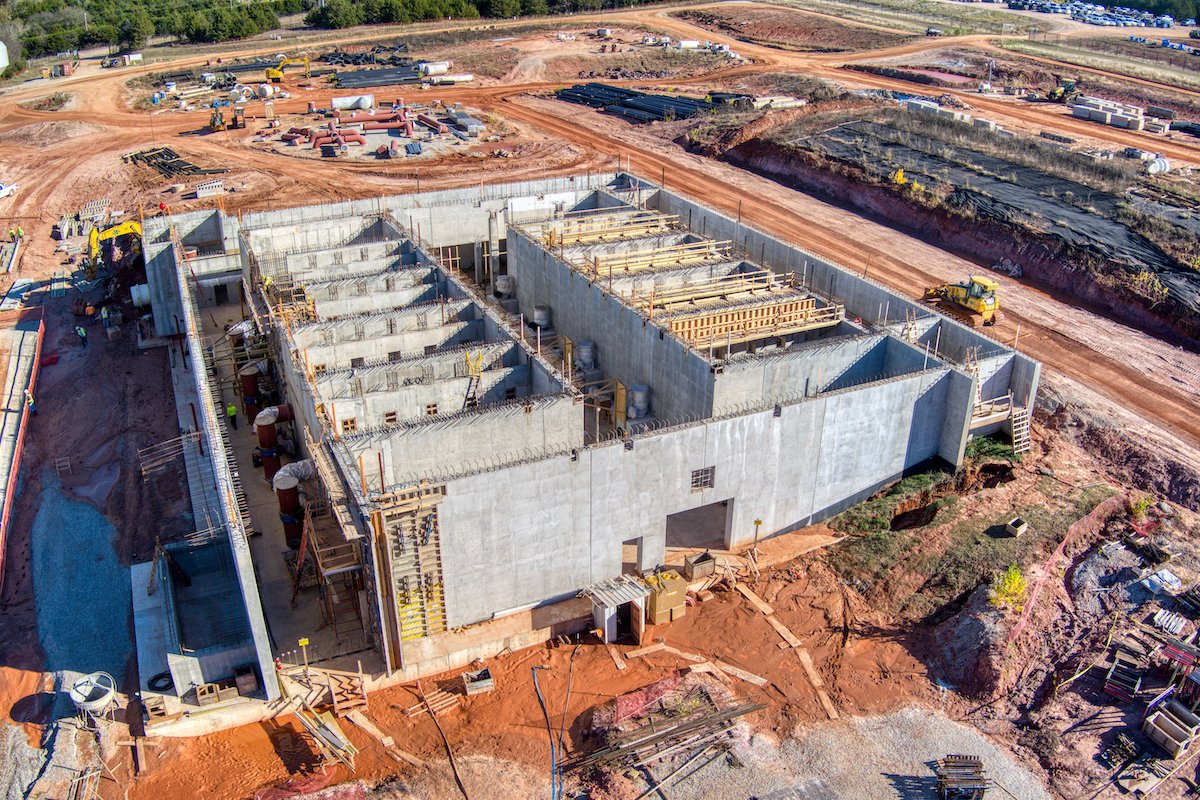
Our role is to build what sits beside them: process-unit pads, tank farms, rail-served warehouses, truck courts and the utilities that support a line. We estimate with the weight of equipment, the length of the rail spur and the elevation of the nearest flood line already on the table.
New investment and old infrastructure
Area Development's Q3 2025 issue describes a $1 billion lithium refinery planned at the Southside Industrial Park West site in Muskogee, with 300 jobs, and two city and county TIF districts, one of them to rehabilitate a branch rail line and reconnect it with Union Pacific. FOX23 reported on July 8, 2025 that Port Muskogee acquired a 125.49-acre site with 81 bordering acres of riverfront property outside the regulatory floodplain, with direct access to Class I rail carriers. Plans of this kind change over time, so an owner should confirm the current status with the port and the city before relying on them.
What the announcements tell a builder is that heavy industrial sites, rail rehabilitation and river terminals are all active here. The pressure points are crews, ready-mix capacity and equipment deliveries. We address them in long-lead procurement management and by reserving trades during preconstruction.
Process pads, tank farms and rail-served buildings
Process work needs foundations that do not move. Pumps, compressors and reactors sit on pads with embedded anchor bolts, grout and sometimes isolation from the building slab, which we handle through equipment pad and foundation work. Where soils are soft or the water table is high, drilled piers or driven piles carry the load. See drilled pier foundations for how we set them.
Rail-served buildings come next. Port Muskogee's 2024 overview lists 5.5 miles of railroad with daily services for Class 1 interchange, cargo transfer and storage, and 312,300-plus tons of rail cargo moved annually. A building that receives cars needs track alignment, a floor that tolerates the point loads and doors sized for the cargo. We coordinate with the rail operator on clearances and with the owner's safety team on switching rules.
Flood heights and river-adjacent ground
Wikipedia reports that in May 2019 river flooding at Muskogee rose more than 42 feet, higher than at any point back to 1943, and that the river reached 39.6 feet in 1986. Flooding is therefore part of any riverfront analysis. The port's 81 acres outside the regulatory floodplain, as reported, shows that elevation varies, and the floodplain administrator is the authority on any parcel.
For a site near the river, we ask what the equipment needs to survive. Electrical gear can be raised on pedestals, pits can be sealed or pumped, and critical storage can be placed above the base flood elevation. These choices cost more at the start and much less than a flood loss. We bring them to the owner during design with prices attached.
Highways and permits
Muskogee is served by US Routes 62, 64 and 69 and State Highway 351, also called the Muskogee Turnpike, according to Wikipedia. Heavy loads leaving a plant must follow permitted routes, and bridge and weight limits can dictate which road is allowed. We map oversize routes during heavy-haul access road design and make sure the entrance can take the turning paths.
The state adopted newer International Codes, and the city building department confirms the edition and amendments that apply to a submittal. Process plants often involve additional agencies, such as the environmental regulators and the fire marshal, and we put each on the permit calendar.
Industries on the river
Metals, glass, paper, chemicals and energy materials are all represented in the area. Our metals and heavy industry work and food and beverage experience cover the process and sanitary requirements that differ between them. Owners looking at a second site can compare the Bartlesville page, and the Tahlequah page for the Cherokee County side of the region.
Building while the plant next door runs
Industrial land in Muskogee is often shared with active neighbors. A glass furnace, a paper machine or a process line cannot stop for our convenience, so vibration, dust and truck traffic are part of the plan. We schedule heavy compaction and pile driving away from sensitive equipment, keep construction deliveries off the plant's shift-change routes and agree on a single point of contact for stops. Our phased construction on occupied sites process documents those rules before the first day.
Tie-ins to existing utilities follow the same logic. Fire water, power and process piping connections are scheduled for planned outages, with materials staged, isolation points verified and a rollback plan if something goes wrong. Owners who plan shutdowns a year ahead get better crews and prices than those who call a month before.
Bring the load, the track and the flood line
Tell us the equipment weights, the rail needs and the parcel you are considering. We will return a scope that includes foundations, flood elevations, access and permits.
Common Questions
Can I build a rail-served plant in Muskogee?
Yes, if the parcel is near existing track and the railroad agrees. The port lists 5.5 miles of railroad and daily Class 1 interchange, and other areas are being reconnected. We assess the spur geometry and cost during the site study.
How should I plan for river flooding?
Check the floodplain status with the city and plan for critical equipment to sit above the base flood elevation. Parcels outside the regulatory floodplain exist, including some riverfront acres, so the answer is parcel by parcel.
Do you build tank and process pads?
Yes. We build foundations, containment curbs and sumps based on the engineer's loads, and we coordinate with the mechanical contractor on anchor bolt placement and grout.
Which codes apply?
The state adopted newer International Codes. Cities enforce their own editions, so we confirm the version and amendments with the Muskogee building department.
How do announcements affect my schedule?
Large projects nearby can tighten labor and ready-mix availability. We reserve trades early and keep long-lead orders on the calendar to protect your dates.