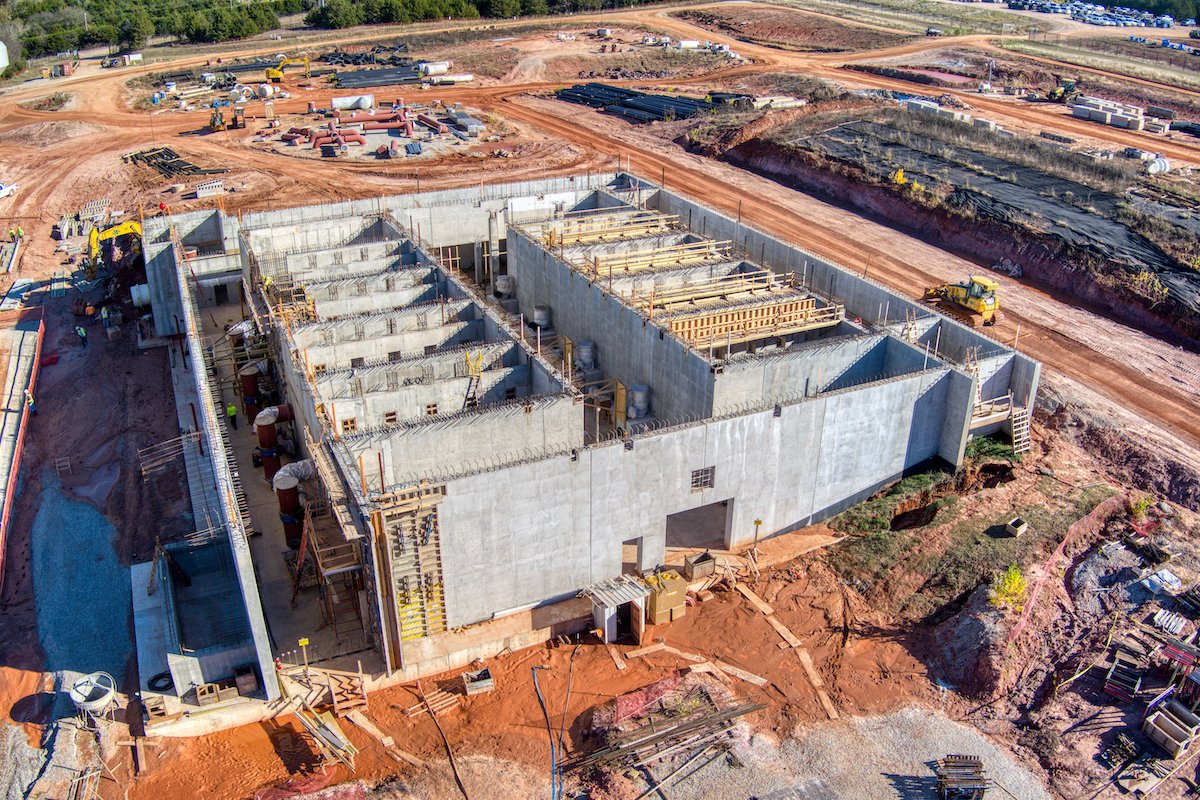
Process and Utility Tie-Ins in Okmulgee
Utility and process tie-ins for new industrial buildings in Okmulgee, including brownfield sites, rail and highway access and outage planning.
Industrial buildings in Okmulgee tend to be built on ground with a history, and the history decides how the utilities go in. We plan and manage process and utility tie-ins for owners building on former industrial land, on new park parcels and beside existing plants, with licensed trade partners performing the field work and our staff scheduling, coordinating, supervising and inspecting it.
A clear local example is the Okmulgee Business Complex, built at Highway 75 and Fairgrounds Road (southwest corner) where a refinery once stood. The state's environmental quality department issued a Brownfield Certificate of No Action Necessary for the property in 2012. Early on, buyers could choose from forty industrial acres, eight commercial lots or three retail pad sites. A buyer on ground like that wants a contractor who asks what is buried, which lines are live and who owns them before a trench is opened.
A second project points the same way. A second brownfield site became a business industrial park when the Okmulgee Area Development Corporation held its groundbreaking in October 2022. Federal money from the Economic Development Administration ($2.1 million) was matched locally with $635,430, and the project anticipates 175 jobs and $50 million of private capital. We have no role in either. They show that new utility work in Okmulgee is likely to meet old infrastructure, and that planning for it pays.
Who needs tie-ins here
Manufacturers, fabricators, food and beverage processors, energy suppliers and logistics users all need utilities, but they use them differently. A processor needs water, drains and steam or hot water. A fabricator needs power, compressed air and gas. A distributor needs power for lighting, docks and refrigeration. We tailor the utility plan to the user, drawing on our work for advanced manufacturing and food and beverage owners.
Okmulgee is served by BNSF Railway on a line built in 1900, and U.S. Route 75 is the main north-south route through the city, 38 miles south of Tulsa. Two more routes, U.S. 62 and Highway 56, reach the city as well. Industrial owners who rely on freight benefit from these routes, and we plan the building, the yard and the utility corridors to leave room for docks, spurs and future growth.
Services that surround a tie-in
A tie-in rarely stands alone. It comes with a site utilities package that covers water, sewer, gas, power and communications; with underground electrical duct banks that carry feeders; and with fire water loops and hydrants where the building requires them. We coordinate these as one set of drawings and one schedule.
For brownfield sites, we add environmental coordination. The owner or the environmental consultant provides the record of past use and any restrictions, and we plan excavation, soil handling and disposal accordingly. Contaminated soil or groundwater must be managed under regulatory requirements, and we make sure the trade partners know the rules before digging begins.
What makes tie-in costs rise or fall
Costs follow distance, depth, capacity and risk. A building near the main line is cheaper to serve than one that needs a long extension. A deep sewer costs more than a shallow one, and a larger service requires larger equipment. Risk shows up as allowances for rock, groundwater, unmarked lines and restoration of pavement.
On a former industrial site, we recommend a contingency for discovery of old foundations, tanks and pipes. We also recommend potholing at crossings during design, since the information can reduce uncertainty and save money. Our estimate lists utility work in its own section, with unit prices for the common changes, so the owner can evaluate them quickly.
Owners sometimes ask whether to build the utilities first or with the building. Building them first gives certainty and lets the lot be marketed as serviced, but it commits capital early. Building them together saves mobilization and keeps trenches open once. We price both approaches and describe the effect on the lender's draw schedule and the opening date.
Planning outages and long lead equipment
Utility providers have their own schedules, and the contractor's schedule must follow them. Electric service, transformers, gas meters and water taps can take weeks or months to arrange. We submit applications during design, track each one weekly and plan the building so that the last tie-in happens close to the end of construction.
When a tie-in affects an existing operation, we plan the outage with the owner, schedule it for the shortest practical window and prepare materials in advance. Okmulgee Regional Airport, run by the Tulsa Airports Improvement Trust from July 1, 2015, has a concrete main runway of 5,150 by 100 feet. When a critical part must arrive by air during a shutdown, we check with the owner and the carrier what the field can receive.
From the property line to the equipment
The scope starts at the point of connection and ends at the equipment: service lines, meters, valves, backflow devices, transformers, panels, conduit, piping and controls. We confirm who owns each piece, who installs it and who pays. Provider-owned equipment often has a separate installation process that the contractor must schedule around.
Nearby cities provide labor and supplies for the work. The pages for Bixby, Jenks and Sapulpa describe how we plan projects in those areas, and a plant in Okmulgee can draw on the same network of trade partners, with travel built into the schedule. A pre-pour or pre-trench meeting with the inspector and the provider's representative, held on the lot, often resolves questions about location, depth and clearance in a single visit.
Settle the utility plan before you settle the layout
Send us the parcel, the load estimate and the date you need service. We will return a utility scope, an outage plan and a price that sets out what is known and what is allowed for.
Common Questions
What should we know before building on a former refinery site?
Ask for the environmental record, any no-action letter and any deed restrictions. Plan for unknown buried items and for soil management rules. A contractor with experience on industrial land can price those risks before you commit.
How early should utility applications be filed?
During design, as soon as the load is known. Providers need time to review, design and build their part, and early filing prevents the building from sitting idle at the end.
Can we avoid a shutdown when connecting to an existing plant?
Sometimes through bypass, hot tap or a second feed, but those methods cost more and need careful review. We compare them with a short planned outage and let the owner decide.
Who coordinates inspections and tests for utility work?
We do. We schedule the building department, the utility provider and any special inspectors, and we make sure testing is complete before the system is energized or filled.
What records do we receive at turnover?
As-built drawings, test reports, permits, manuals, warranties and a list of valves and breakers with their locations. This package helps maintenance staff and future contractors, and we walk the owner's team through it so the first repair or expansion starts from accurate information instead of a guess about what is underground.