Contractor Yards and Small-Bay Industrial in Mustang
Contractor shops, equipment yards and small-bay industrial buildings in Mustang, with stabilized yards and access planning along SH-152 and SH-4.
Service contractors outgrowing a rented shop need a building, a yard and a gate they can control, and Mustang is a growing place to find them. We build contractor shops, equipment yards, small-bay industrial space and stabilized parking for the trades, haulers and suppliers that serve the southwest side of the metro. The projects are modest in scale compared with a distribution center, but each depends on getting a few practical things right: truck access, drainage, power and room to grow.
The road network is the starting point. State Highway 152 passes through Mustang and ends on its east side, overlapping State Highway 4 for about one mile between Mustang Road and Sara Road. The Greater Oklahoma City Chamber describes the city as served by both highways and as five minutes south of Interstate 40. We design the entrance and the yard to suit whichever route the owner's vehicles will use most.
The southern extension of the John Kilpatrick Turnpike to SH-152, whose west ramp is signed for Mustang, opened in stages in 2020, westbound on January 9 and eastbound between January 28 and February 14. That added a faster route around the metro, which matters to any operator with customers across several cities.
From dirt lot to working yard
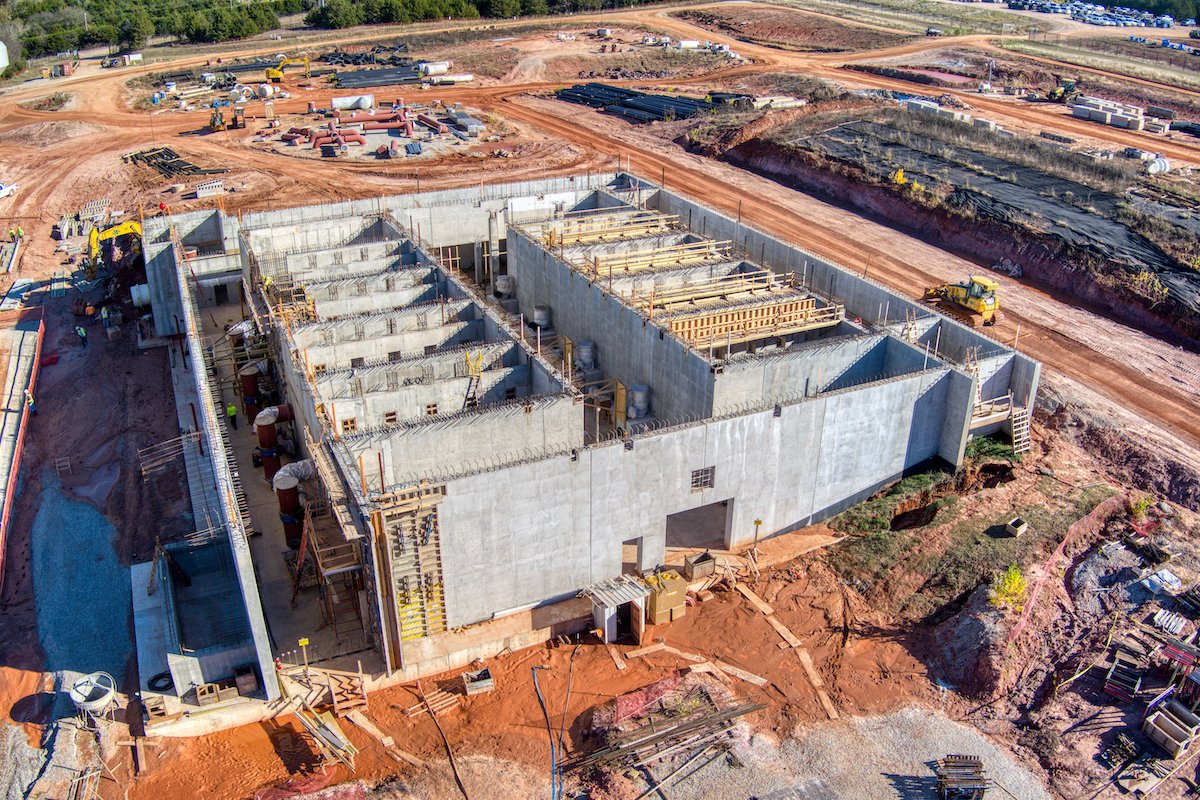
A typical Mustang contractor project begins with clearing, grading and a pad, followed by utilities, a building and a yard. We build metal-framed shops with overhead doors, a small office and storage, along with stabilized laydown yards for pipe, equipment and materials. The yard is as important as the building because it is where the daily work happens.
Stabilizing the yard keeps vehicles from rutting the surface in wet weather. Depending on the soil and the loads, that can mean a lime- or cement-treated subgrade, a compacted aggregate base or concrete in the highest-traffic spots. We recommend the lightest section that will last and explain the trade-off against repair and downtime, so the owner can decide on facts.
Fencing, gates and lighting come next. A yard that holds equipment worth more than the building needs a perimeter that is hard to cross, lighting that covers the corners and a gate that trucks can clear without blocking the road. We place the gate far enough back from the highway for a trailer to stop off the pavement, which is a rule of thumb that keeps neighbors and the highway department happy.
Water, power and what the lot allows
Before a contractor buys a lot, we encourage a short feasibility review. We confirm zoning for outdoor storage, setback and screening requirements, driveway access to the state route, the distance to water, sewer and electric service, and the floodplain status. A parcel that looks ideal can be the wrong choice if the nearest sewer main is a quarter mile away.
Drainage is the second check. Hard surfaces increase runoff, and the city will want a detention plan or fee. We design detention that is also useful, for example a shallow basin that doubles as overflow parking in dry weather, and make sure outfalls do not send water onto neighbors. Our stormwater detention and drainage work follows the same practice. Last, we confirm the permits that surround the building: driveway, floodplain, fire access and, when fuel or fluids are stored, containment. Containment under a fuel tank or a wash pad is not optional equipment, and the cost is small if it is in the plan from the start.
Keeping a small project affordable
Small projects have little room for waste, so we look hard at the number of times a crew has to mobilize. Earthwork, utilities and concrete are sequenced to run back to back, and we offer a base scope plus alternates, such as extra bays or a larger office, that can be added if the numbers work.
Growth is part of the budget conversation. Mustang's population was 19,879 at the 2020 census, a 14.3 percent increase from 17,398 in 2010, which is useful context for an owner thinking about customers but not a forecast. If the owner expects the business to grow, we plan the utility sizes, the yard drainage and the building footprint so an addition can be built without tearing out what was just installed.
One crew, one set of answers
Our approach on smaller projects is simple: a project manager who knows the owner, a superintendent who is on site daily and a short list of subcontractors we have worked with before. The owner gets one call for answers, not five, and we hold a weekly walk-through to catch small problems early.
We also explain what the building will cost to operate. Insulation, door choices and lighting affect monthly bills, and for a shop that runs six days a week, they matter. When it fits the owner's plan, we consider a pre-engineered metal building as the most economical frame.
Neighboring work
Mustang projects are coordinated with those in Yukon and Oklahoma City, and owners who need a larger program can look at industrial tenant improvements or utilities and power support facilities for service companies working in that sector. A few operators come to us with an existing building they want to update, not replace. We look at that too, starting with a condition survey of the slab, the roof and the electrical service, so the owner can compare renovation cost with new construction.
Size the yard before you buy the lot
Tell us how many vehicles, trailers and bays you need today and how many you expect to need later. We will test the parcel against that list and tell you plainly whether it fits, what it will take to make it work and what it will cost.
Common Questions
Do I need paving in my contractor yard?
Not always. A stabilized aggregate surface can serve well if drainage is right and loads are moderate. Concrete is often used at the gate, the fuel area and the wash pad. We recommend a mix based on your equipment and the soil.
What road access does Mustang offer?
State Highway 152 passes through the city and overlaps State Highway 4 for about a mile, and the Kilpatrick Turnpike's southern extension to SH-152 opened in 2020. We check which route your vehicles will use and design the driveway to match.
Can you design a shop that can be expanded?
Yes. We size utilities, drainage and the foundation line for future bays, and we locate the building so the expansion side is clear. This costs little at the start and saves a good deal later.
How long does a small shop and yard project take?
Often several months from notice to proceed, depending on permits, steel delivery and weather. We separate the permit timeline from construction in the proposal so you can see what is in our control.