Equipment Foundations and Heavy Pads in Anadarko
Anadarko owners installing presses, tanks and processing lines get engineered foundations planned for Washita valley soils, weather and equipment delivery.
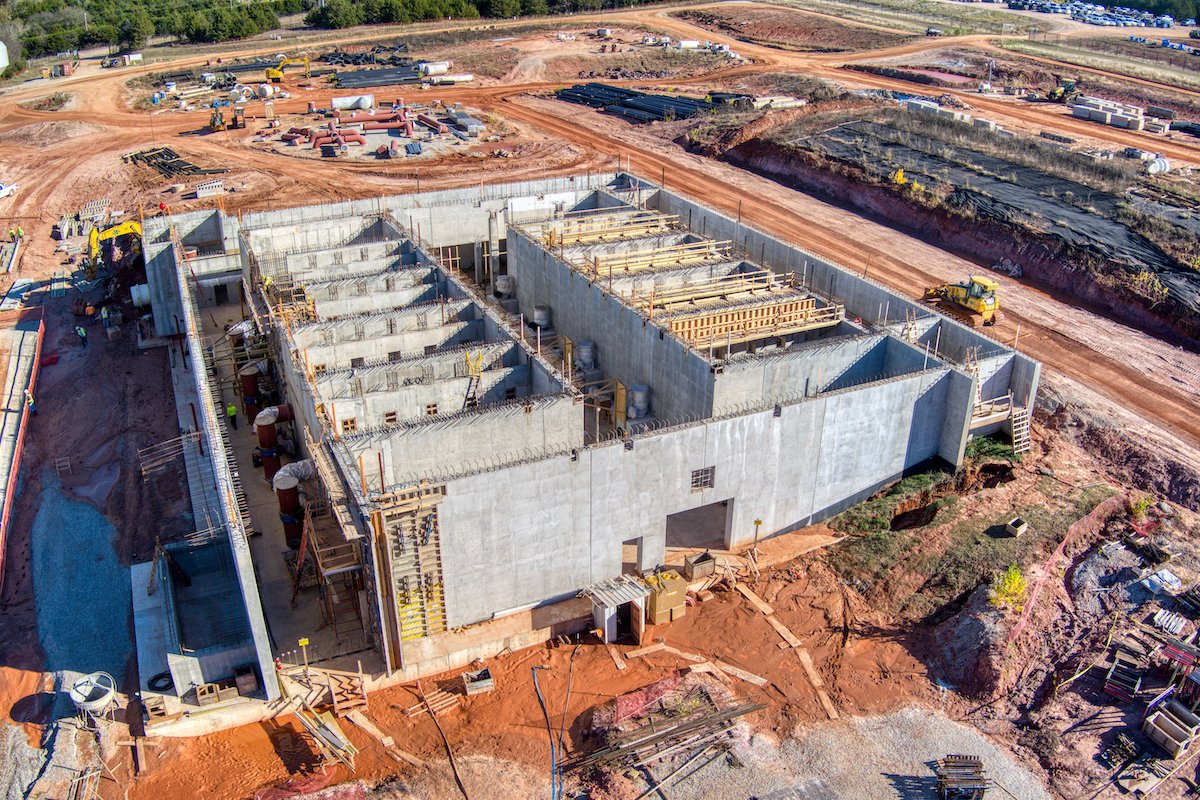
Presses, mixers, storage tanks and processing lines all depend on the pads beneath them, and owners in Anadarko who are adding heavy equipment need those pads designed, permitted and built before the machine arrives. We handle that sequence as general contractor: the geotechnical report, the engineered foundation, the reinforcing, the placement and the cure, with trade partners scheduled and supervised by us and each stage inspected before the next one covers it.
Chickasha lies about 18 miles east of Anadarko, which sits at the crossing of US 62 with State Highway 9 and US 281 with State Highway 8, so steel, rebar and ready-mix come in over established highways. Union Pacific rail also serves the town. For an owner planning a heavy load, delivery by rail or an oversize truck should be considered before the foundation is designed, since lifting equipment and lay-down space follow the delivery method.
The town stands on the Washita River's southern bank, and the valley soils that suit crops and livestock are not always the soils that suit heavy foundations. Alluvial ground can be soft or variable, so we investigate before committing to a pad type. Where the soil is weak, piers, improved subgrade or a thickened mat can carry loads that ordinary footings cannot, and we price those options before the owner decides. The comparison is simple: cost now against settlement risk later.
Engineering, permits and inspections
A heavy pad starts with the equipment manufacturer's drawings, which state weight, dynamic loads, anchor bolt layout and tolerances. A structural engineer converts those into a foundation design, and the local building department reviews it before work begins. We coordinate those submittals and make sure the permit covers excavation, concrete and any associated utility work.
During construction, a testing agency checks soil bearing, reinforcement, concrete strength and anchor bolt placement. We schedule those visits in advance so crews are not waiting, and we keep reports in an organized file for the owner and for any future equipment replacement. If a test result falls short, we stop, notify the engineer and agree on a fix before the next step.
An agricultural economy that processes what it grows
Agriculture has been the economic mainstay of the area, and in 2000 federal and tribal offices employed 540 people in town. Those facts point to a market where storage, processing and service buildings matter more than large factories, and where owners often want equipment installed economically.
That suits our approach. Grain handling equipment, feed systems, water treatment skids and small fabrication machinery all need foundations designed for their actual loads, not oversized out of caution. We help owners size pads correctly and keep records of the design basis, which saves concrete and avoids the failures that come from underdesign. For tanks and bins, we also look at settlement over time, because a pad that moves unevenly can strain pipe connections and ladders long after the day it was poured.
Buildings that cover heavy equipment
Equipment may sit outdoors on a pad, under a canopy or inside a building. A food and beverage processing building adds washdown floors, drains and sanitary finishes around the equipment. A manufacturing plant adds crane rails, high power and bays for material handling.
We ask the owner where the machine will sit, how it will be served and how it will be replaced in the future. A door sized for the first machine is rarely adequate for the second, so we plan the openings and the foundation for the largest piece likely to enter or leave. Floor drains, trench covers and bollards are located with the equipment layout so that forklifts and carts do not damage them.
Owners and industries we plan for
Food and agricultural processors will find relevant experience in our food and beverage work, where floors, drainage and temperature are as important as the pads. Fabrication shops and equipment manufacturers benefit from stiff, flat foundations that hold alignment over time, and they often add a mezzanine, a platform or a crane bay to the same project.
Tribal and public owners often require specific procurement steps, bonding or reporting, and we adapt our proposals to them. We also work with deep foundations and piers when the Washita valley soils call for them.
What a heavy pad costs and why
Soil quality, load, thickness, reinforcement and special embeds set the cost. Weather adds another variable: local records show about 31.63 inches of rain and melt in an average year, with temperatures that have reached 111 degrees Fahrenheit and fallen to minus 17. Hot-weather placement needs retarders, shading and early starts, while cold-weather placement needs blankets, heaters and protection from freezing.
We include those measures in the price when the schedule puts the pour in a hard season. If the owner can move the date, we show the savings. We also give unit prices for unexpected conditions such as unsuitable soil, so any adjustment is calculated on a known basis. Owners who want to hold the budget can phase the work, building the pad for the first machine now and the pad for the next unit later.
Placing the pour between rain, heat and deliveries
Foundation work is highly sensitive to weather and to delivery of the equipment. We schedule excavation and formwork so the concrete can be placed in a good window, then allow the full cure before the machine is set. Anchor bolt templates, reinforcement and embeds are delivered ahead of the pour and checked by survey. Ready-mix is ordered for a fixed time, with a backup supplier named in case of breakdown, and the pour team is briefed on finishing and curing steps.
When equipment arrives by rail or oversize truck, we coordinate the route, permits and cranes. Owners who also work in Chickasha, Lawton or Mustang can expect the same disciplined approach to the pour, the cure and the handover.
Send us the equipment and the site in Anadarko
Share the equipment drawings, the location and the date the machine arrives. We will return a foundation scope, a schedule and a price for your Anadarko project.
Common Questions
How do you know what size pad a machine needs?
The manufacturer's drawings state the weight and the loads, and an engineer designs the pad for those and for the soil. We do not guess. If drawings are not yet available, we price a budget allowance and update it when they arrive.
What if the soil beneath the site is soft?
We test first. Options include replacing soil, compacting it, thickening the pad or driving or drilling piers to a firmer layer. We show the cost and risk of each so the owner can choose.
Does summer heat or winter cold change the pour?
Yes. Hot weather speeds setting and can cause cracking, so we use set controls, early starts and curing methods that hold moisture. Cold weather slows strength gain and risks freezing, so we use blankets and heat. Both are priced in.
How long before we can set the equipment?
Usually after the concrete reaches the strength the engineer specifies, which is confirmed by tests. The time varies with mix and weather. We include the cure in the schedule and tell you the earliest safe date.