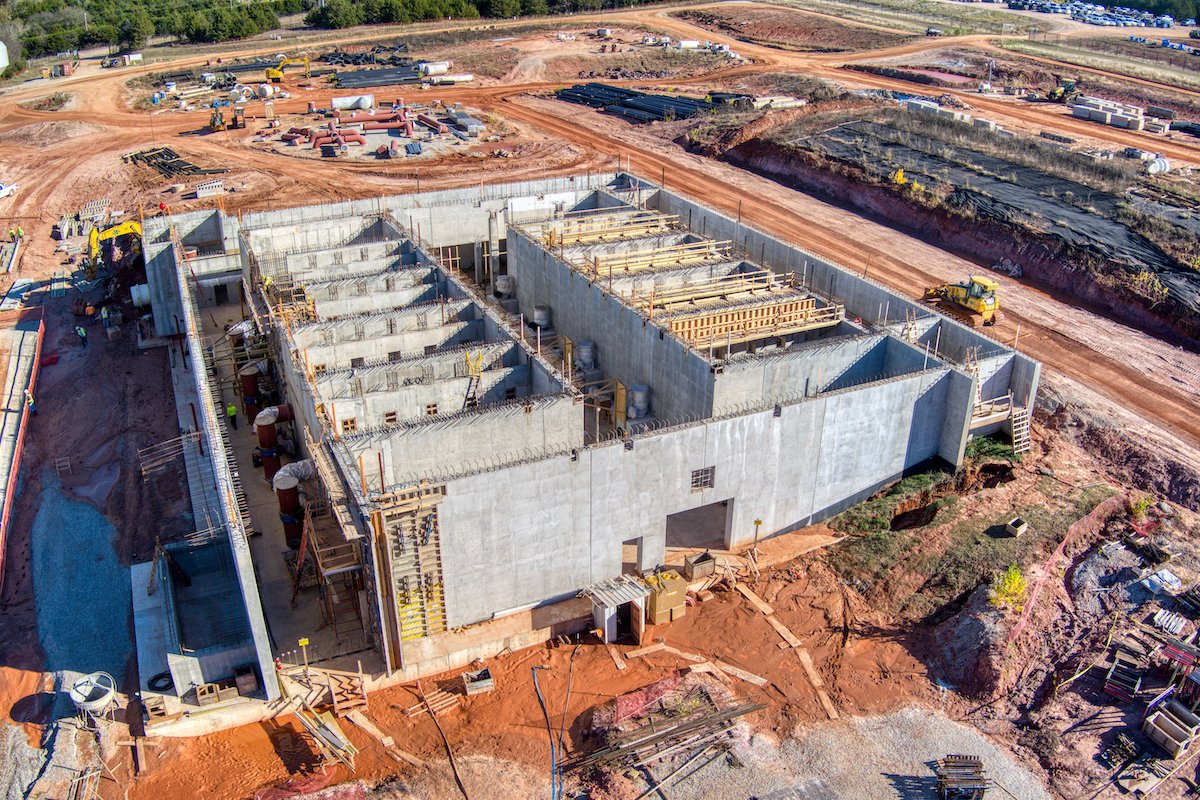
Pipeline and Energy Facility Construction in Poteau
Pipeline, fuel and energy owners near Poteau get construction planned around live product lines, river valley soils and tight outage and permit windows.
Owners of fuel handling sites, pipeline facilities and energy plants around Poteau need a builder who treats every product line as a live hazard. We plan the work so that new foundations, buildings and utilities go in without putting a pressurized line, a tank farm or a control building at risk. We schedule and supervise the trade partners, and we keep the owner's operators informed about what is being excavated, lifted or welded near their equipment.
The ground here asks for care. The town lies low beside the Poteau River, with Cavanal Hill reaching a summit of 2,385 feet above sea level overhead. Valley soils, runoff from the hill and the nearby river all affect how a pad is drained and how deep a footing must go. Lake Wister, a reservoir fed by the Poteau River and by Fourche Maline creek, got its flood-control authorization in 1938, reached full operation in December 1949 and covers 7,300 acres, so floodplain questions are a normal part of site review.
Owners who are weighing an industrial park or a rail-served parcel for a later phase get the same planning. We can lay out how a future plant, laydown yard or loading area would fit the ground before they commit, including where a truck court, a rail connection or a pipe rack could go without blocking the next expansion.
Poteau sites and the roads that reach them
State Highways 83 and 112 join US 59, 270 and 271 around Poteau, which gives trucks several approaches to a plant gate. We choose the route for each delivery based on turning radius, bridge limits and school or town traffic, then put it in the delivery plan so drivers do not improvise.
For work that reaches beyond town, our pages on McAlester and Muskogee describe how we run projects in neighboring markets with the same safety program.
Building near product lines
We begin with a drawing review and a site walk that marks every buried line, overhead crossing and valve we can find. Anything we cannot confirm is treated as live until proven otherwise, and we use hand digging or vacuum excavation in the zone around it.
The plan then divides the job into areas that can be isolated from operations. Each area has its own access, barricades and permit requirements, and the owner's operators sign off before a trade partner enters. If conditions change, work stops in that area and starts again only after the plan is updated and the owner agrees.
Fitting construction into the operating calendar
Energy and pipeline owners have seasons of high demand, planned maintenance and regulatory deadlines, and the construction schedule has to respect all of them. We lay out the project against those dates and mark the periods when crane work, shutdowns or tie-ins are possible.
The small city airport south of town, a 175-acre facility with a 4,007-foot runway, can help a specialist or part arrive quickly. Heavy equipment still moves by road, so we confirm routes and permits early.
What the local setting means for a builder
The area combines river valley, hillside and highway corridors, so sites are rarely flat and uniform. A pad that sits well on one parcel may need a deeper footing or a different drainage plan on the next, and access can differ from one side of town to the other.
That variety is why we favor a geotechnical report and a topographic survey before pricing anything firm. Owners who ask for a quick number get a range with the assumptions listed, and we narrow it as information arrives. A fair early number tells the owner whether the site is worth pursuing, and it is much better than a firm price built on guesses.
Hot work, lockout and access control
Hot work near hydrocarbon systems follows the owner's permit program, with gas testing, fire watches and written release at the end of the shift. Lockout and tagout are done by the owner's authorized staff, and our supervisors verify the boundaries before anyone starts.
We orient every trade partner crew, track who is on site and keep a daily safety record. Short, specific toolbox talks about the day's hazards do more good than a long generic one, so that is the format we use. Near product lines we also review the emergency plan with each crew, including muster points, shutoff locations and who calls the plant control room.
Services that support energy-adjacent work
Grading and drainage are central in valley sites, so we plan stormwater detention and drainage with the building rather than after it. Owners who need approvals from several agencies can lean on our permitting and entitlements coordination to keep applications moving.
Both help avoid late surprises, which cost the most on a site that cannot easily stop.
Owners and operators we plan for
Our utilities and power work centers on outages, redundancy and safe access, which transfers directly to pipeline and fuel owners. Light buildings for controls, spares and maintenance often take the form of a pre-engineered metal building that goes up quickly beside the process area.
Whatever the building, the starting point is the same: how will it be used and who must be able to reach it in an emergency.
What moves the price on energy-adjacent projects
Restricted access, hand excavation and extra inspection raise cost far more than square footage does. Weather, soil conditions near the river and the time it takes to obtain permits add further variation.
We list the major assumptions in each proposal, show the allowance we carry for unknowns and explain how a change would be priced. Owners compare options with that information in hand and can decide whether to accept more risk or pay for more certainty.
Tell us about your Poteau site and the lines nearby
Send us the facility, the lines and tanks near the work and the dates that matter. We will return a safe sequence, a scope and a price for your Poteau project.
Common Questions
Do you build near active pipelines?
Yes, with a plan that locates and marks every line first, then keeps work outside agreed distances unless the owner approves. We use hand or vacuum excavation near known lines and stop when something unexpected appears. The owner's operators decide whether work resumes.
How does the river valley affect a project here?
Low ground, hillside runoff and the flood-control lake nearby make drainage and floor elevation key design questions. We review maps, order soil testing and set slab heights with margin. Detention and grading are planned with the building, not added later.
Can you work during a plant shutdown?
Shutdown work is a normal part of what we plan. We prepare materials and prefabricate off the unit, then use the shutdown window for the tie-ins only. The sequence is written out hour by hour with the owner's planner.
How early do permits need to start?
Right away, because reviews often decide the start date. We list each agency, application and inspection in the calendar when the scope is first drawn. Owners see the dates that depend on approvals and can decide where to build in float.
What does a site investigation cost compared with the benefit?
It is a small part of the budget and often saves the most. Soil borings, a survey and a utility locate prevent change orders for rock, wet soil or unmarked lines. We recommend them on any project that involves heavy loads.