Industrial Park and Rail-Served Sites in Blackwell
Blackwell industrial park buyers get site work, rail access, heavy pads and buildings planned together, with utilities and drainage priced before purchase.
Companies choosing ground in the Blackwell Industrial Park want to know what it takes to turn open acreage into a working plant, and what the heavy equipment inside will require from the ground. We answer with a site-first plan: grading, drainage, utilities, rail and truck access, pads and the building, all scheduled and supervised through trade partners so the owner has one contact for cost and time.
The location offers choices. Three routes reach Blackwell: State Highway 11, US-177 and the interstate (I-35), and the Chikaskia River runs beside it. The industrial park spans 500 acres with rail service, a short drive from the I-35 corridor, and a separate 143-acre site lies north of it, still under 3 miles from the interstate. One favors the highway, the other favors room for growth, and owners can weigh them.
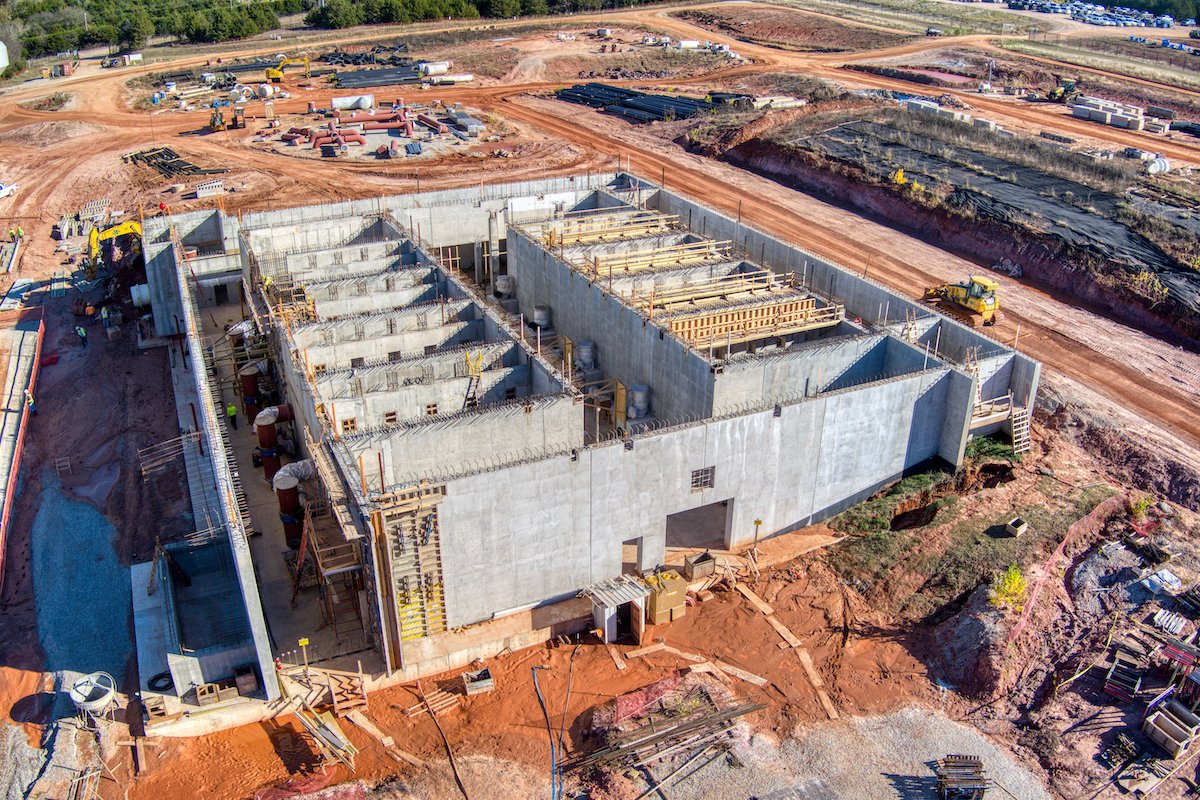
Plants in a park tend to carry large machines, tanks and conveyors, so the heavy pads and foundations are often the decisive part of the budget. We treat them as part of the site plan, not an afterthought, and we ask equipment suppliers for loads, anchor bolt layouts and tolerances before final layout is chosen. The answers decide slab thickness, pit locations and crane access, and they are cheaper to settle on paper than after the first pour.
Turning acreage into a buildable plan
We start with a parcel study. It covers soils, drainage, utility capacity, rail connection, truck routes, setbacks and the owner's future expansion. A sketch layout shows the building, yard, pads, access and utility corridors in a single drawing, with notes about what each choice costs.
From that sketch the owner picks a direction and we price it in layers: site, utilities, pavement, foundations and building. Each layer carries its assumptions and allowances, so changes are easy to evaluate, and so the owner can see which parts of the budget are firm and which are still estimates. We keep the first two phases of growth in mind, leaving space for extra bays, a second rail track or a larger truck court without moving what has just been built. A tilt-wall building or a metal shell can then grow by bays along a planned side. When the number is accepted, the schedule is set backward from the date the owner needs to be operating.
Rail, river and room to grow
A rail-served park raises design questions that a plain lot does not. Track location governs building position, door elevation and the way trucks and rail cars use the yard. Our rail spur site improvements cover grading, ballast support, crossings and the pavement beside the track, coordinated with the railroad's standards.
The Chikaskia River and local creeks affect drainage and, in some places, flood review. We examine the mapping and shape the grade so that stormwater leaves the building area and reaches approved outlets. Larger parcels also need haul roads and erosion controls during construction, and we plan them before earthwork begins. Our site clearing and mass grading work balances cut and fill where it can, which lowers hauling cost and keeps trucks off public roads.
Land the city is preparing for industry
A report dated November 27, 2023 said the city council had taken a first step to bring over 600 acres into play for industry. That land includes 145 acres held by the local industrial authority and 500 acres held by the state's land office, in an area framed by Highway 11 and by 29th Street, Adobe Road and 13th Street. For a buyer, this indicates that more ground may become available and that the city is willing to extend its limits to meet industrial demand.
Freight service has changed too. Between 2006 and 2024 a different short line ran the track, and Farmrail's affiliate Land Rush Rail Corporation has since taken over. We contact the current operator at the start of any rail-connected project to confirm requirements for switches, clearances and loading. A change of operator can alter service rules and schedules, so we ask about both and put the answers in the project file.
Reaching Blackwell and the region
I-35 gives Blackwell a direct path to the north and south, while US-177 and State Highway 11 connect with neighboring communities. The Blackwell-Tonkawa airport serves both towns for business aviation, which is useful for executives and engineers who visit during design and startup.
Owners in the region can compare approaches on our pages for Ponca City, Enid and Stillwater. We use the same planning methods on each site, adapted to local suppliers and agencies. Owners in advanced manufacturing and other process industries often visit more than one market before choosing, and we help them compare.
Safety on an open industrial site
Large sites give crews room, but they also put heavy equipment, trucks and rail close together. We write a traffic plan, separate pedestrian routes, require spotters at crossings and control access to the yard. Excavation is protected, and trench safety is checked each day.
Work beside an active railroad requires additional training and flagging, which we arrange with the operator. We hold a start-up meeting with every trade partner, review the hazards of their tasks and record attendance. Weekly audits confirm that the plan is working and give us a chance to adjust before a small problem becomes an incident. Machines that need equipment pads and foundations are marked with barricades until the concrete is cured and released by the engineer.
Tell us which Blackwell parcel you are considering
Send us the parcel, the process and your target start date. Our reply will cover the site plan, the schedule and the cost of your Blackwell facility.
Common Questions
How do I compare two industrial sites?
Compare total installed cost, not land price alone. Include utility extensions, fill, drainage, pavement and rail connection, then add the schedule. We prepare a side-by-side estimate for each candidate so the answer is clear.
What does rail service add to a project?
Track connections require approval from the railroad, specific clearances and a different pavement design near the rails. They also give the plant a shipping option. We coordinate design with the operator so the connection is accepted when construction ends.
Can you build the heavy pads before the building?
Yes, when the equipment arrives early or the schedule demands it. We protect the pads, set embeds and keep the area drained until the shell is built. The engineer decides what is acceptable. A short written procedure covers cure time, protection from rain and the point at which equipment can be set.
What should we ask the city before buying?
Ask about utility capacity, zoning, annexation, impact fees, drainage rules and expected review times. We can prepare the questions and meet with staff on your behalf. Written answers go into the project file, which helps if staff or rules change during design.
How quickly can a plant be built in a park?
The time depends on the building and the approvals, but a prepared park lot often saves months of site work. Ordering long-lead equipment and submitting permits early reduces the schedule more than anything else.