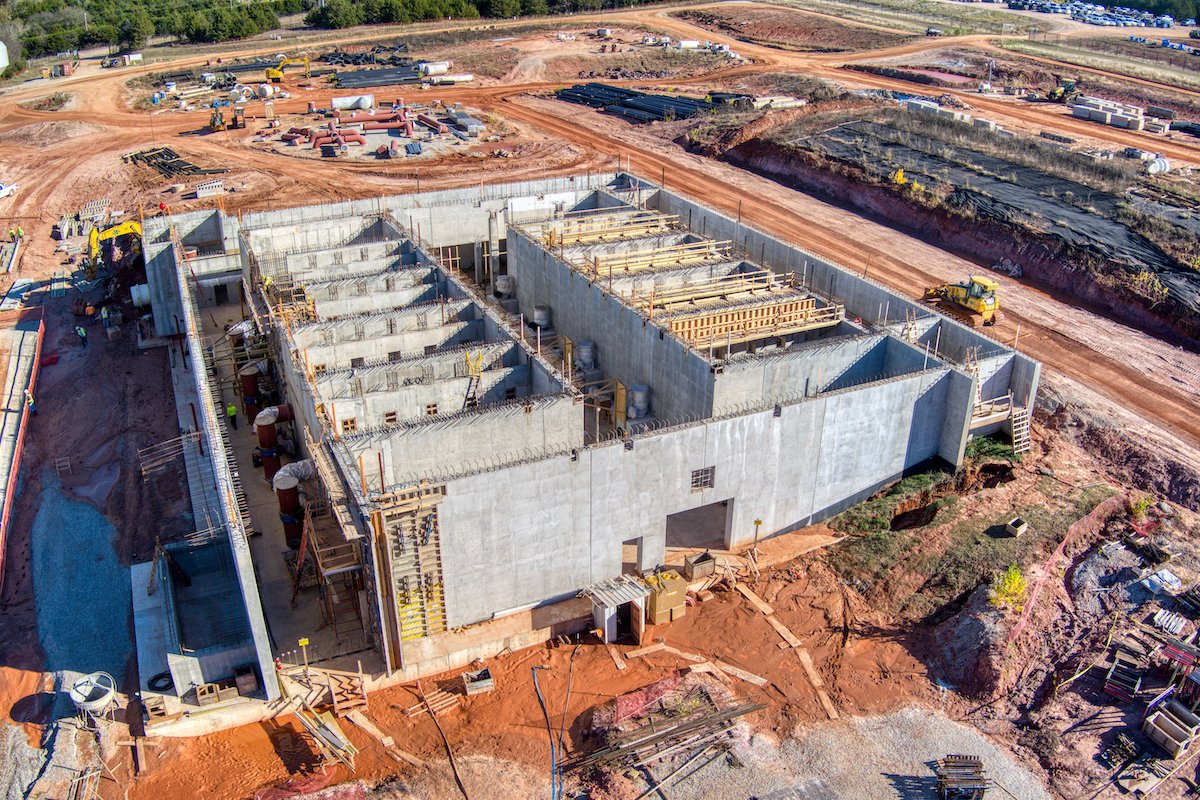
Industrial Park and Port Site Construction for The Village
Construction planning for The Village owners moving to industrial parks and port sites, with parcel comparison, heavy pads and site safety.
Companies headquartered in The Village rarely build their heavy facilities in town, because there is little room for them, and that sends their projects to industrial parks, rail-served tracts and river port sites elsewhere in the state. We help those owners compare sites, price what each one needs and build on the one they choose, with the same managed approach whether the ground sits in the metro or farther afield.
The Village is a small place, roughly 2.56 square miles with ground near 1,191 feet, and Oklahoma City nearly encloses it while Nichols Hills lies along one edge. A corporate office can be located in a place like that for good reasons, but it leaves little room for a warehouse, a fabrication yard or an equipment base. The community is home to the headquarters of a major travel center operator and to Casady School, and on November 15, 2013 that operator purchased three office buildings in Oklahoma City that add up to 227,000 square feet, at the corner of 63rd Street and Lake Hefner Parkway, buying them from an energy company to make room for expansion. Headquarters space and yard space are different problems, and the second one is where we come in.
That history is useful to a builder because it shows how headquarters growth works in practice: offices fill, operations move, and the heavy work follows the land. We do not build for those organizations here, but we know what happens when a business that outgrows a small enclave needs yards, shops and pads on a larger parcel.
Where an enclave's industrial work goes
Because The Village is surrounded by Oklahoma City, most of its owners look to the city, to Del City and to Edmond for light industrial parcels, and to the Port of Catoosa and other rail and river locations for heavy cargo. We work in each of those markets and compare them on road access, utility capacity, price and entitlement risk. A parcel that looks cheap can carry a long utility extension, a drainage easement or a zoning step, and we put each of those items beside the land price in the comparison.
For a project that straddles two sites, such as an office in town and a yard elsewhere, we plan the shared items once: standard details, procurement and the owner's quality records.
Comparing parks and ports before buying ground
Before an owner signs a contract on land, we walk each candidate parcel and look at what it will take to make it usable. That includes truck access, rail spur potential, flood status, soil quality and distance to the nearest water, power and sewer connections. We summarize each parcel in a short comparison so the decision rests on cost to build, not only price per acre.
At a port or industrial park, we also read the covenants and tenant rules, because they may limit building height, outdoor storage, lighting or truck hours. We would rather learn that on a call than after a foundation is poured. The same review covers whether a parcel can accept a truck court with room for trailers to turn and queue, since a site that backs trucks into a public road is hard to fix later. When an owner is torn between two parcels, we price a conceptual layout on each so the difference is measured in dollars and weeks.
Why headquarters growth moves operations outward
An organization that expands its headquarters inside a small enclave soon needs a warehouse, a vehicle shop or a training yard somewhere else. A corporate campus fills with people, and the supporting operations are pushed to land that can take trucks and open storage.
That pattern is why owners with roots in The Village often ask us about warehouses and logistics and distribution sites rather than about buildings in town. We help translate a growing company's plans into a parcel size, a building size and a yard layout. A useful rule of thumb is to ask how many trucks and employees the new site will see on its busiest day, then size the yard, parking and building from that answer rather than from the average.
Pads, floors and the ground under heavy equipment
Many industrial sites need heavy pads: a slab for a generator, a foundation for a compressor or a reinforced area for a crane or a forklift fleet. Our equipment pads and foundations work starts with the vendor drawings, the soil report and the loads, then sizes the thickness, reinforcement and joints to match.
We also look at how the pad will be reached for service and replacement. A heavy machine that cannot be removed without tearing up a floor is a future problem, and a simple access path drawn into the first plan costs little. Floors that will carry rolling loads need joint layouts that keep wheels from catching, and we confirm flatness requirements with the equipment supplier before the pour is scheduled.
Safety at a shared park or port
Industrial parks and port sites often have several tenants working at the same time, so we coordinate with neighbors on shared roads, lay-down areas and truck movements. Every worker on one of our sites receives a briefing, and we mark the boundary between our work and the neighbors' property. Visitors sign in, vehicles park in a marked area and deliveries are met at the gate by someone who knows where the load is going.
Near water or rail we add controls for fall protection, mobile equipment and traffic. Hot work, trenching and crane lifts each get their own permit before the work begins. Where a park shares a fire water system with other tenants, we confirm with its operator how and when a section may be taken out of service, so that our schedule never leaves a neighbor unprotected.
Compare the parcels with us
If your headquarters is in The Village and your next facility needs more room, send us the sites you are considering. We will compare them on cost to build and return a plan for the one you choose.
Common Questions
Can you help us find industrial land if our office is in The Village?
We can evaluate parcels you are considering, comparing truck access, utilities, drainage, rail potential and entitlement risk. We do not sell land, but we price what each site will cost to develop so you can choose with real numbers.
What is the difference between an industrial park and a port site?
An industrial park offers prepared lots and utilities with covenants set by the park. A port or river site adds barge, rail or heavy cargo access, with its own rules and traffic. We read the rules of each before advising on layout.
How heavy a pad can you build?
It depends on the equipment, the soil and the support conditions. We size pads from vendor drawings and a geotechnical report, and we coordinate reinforcement, anchor bolt layout and cure time with the trade partners.
Can a project be split between an office in town and a yard elsewhere?
Yes. We coordinate the two as a single program, with shared standards and procurement, and we schedule so that the yard is ready when the operation moves.