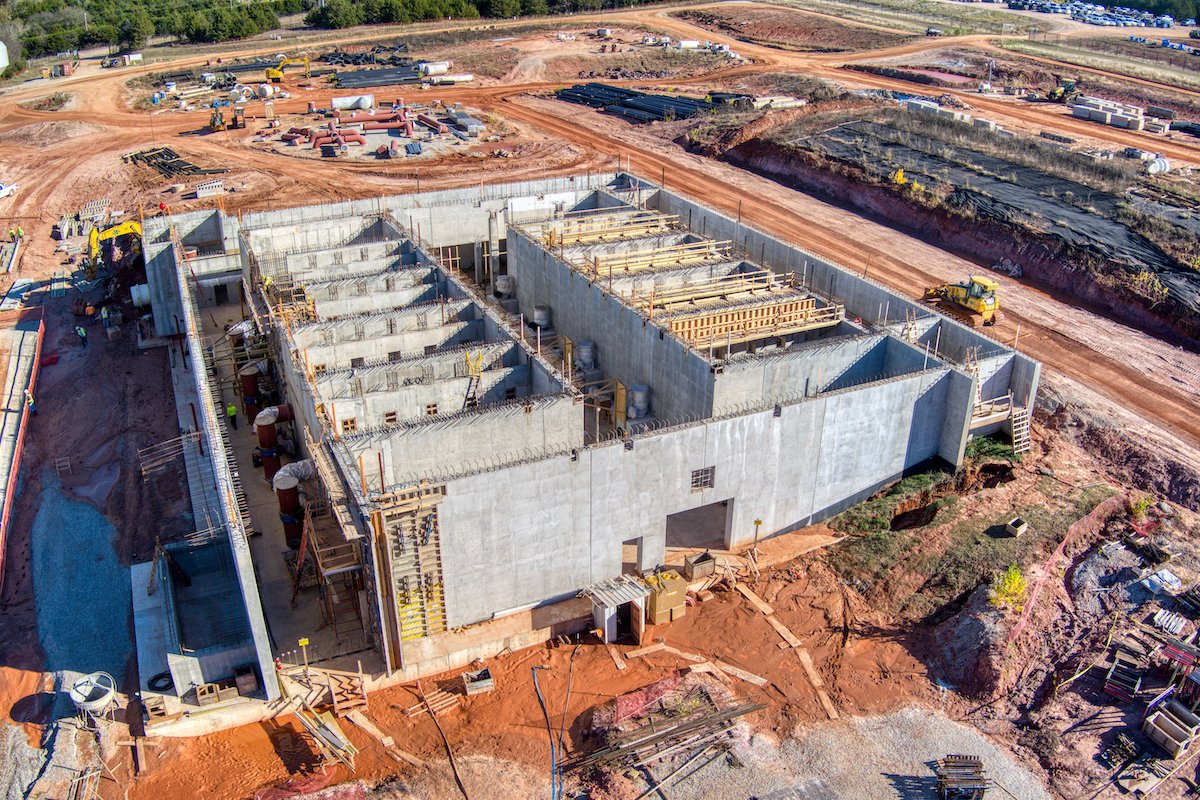
Aviation Support and Industrial Air Park Construction in Altus
Hangar-adjacent buildings, air park industrial sites and heavy slabs in Altus, planned around US 62, US 283, the regional airport and storm risk.
Aviation support buildings share a few traits that make them different from ordinary warehouses: wide clear spans, floors that stay flat under heavy tow equipment, doors that are large and reliable and utilities that do not fail when a shift is on the clock. We build industrial and support facilities for owners in the Altus area, where aircraft training and flying activity shape what neighboring businesses need.
A 2014 report on construction of KC-46 facilities at Altus Air Force Base valued them at $56 million and listed a flight training center, a fuselage training facility and new aircraft hangars, with a goal of instructing about 475 aircrew each year once the training mission was fully operational by 2023. That work was done for the Air Force, and we are not claiming any part in it. We cite it because it shows what a mature aviation market asks of its builders: training spaces, hangar structures and support buildings that must be right the first time.
Private owners who sell to or live near such a mission have their own needs. A machine shop that repairs ground equipment, a contractor yard, a parts warehouse or a freight handler each needs a building that works hard and costs less than the hangars next door. We design and build to that level, not to a showpiece standard, while still using the detailing that keeps floors, doors and roofs working for years.
Industrial air park sites and public funds
An October 4, 2022 report said the Altus Industrial Air Park will receive $4 million in federal ARPA funds and $4 million from the state PREP fund. Public funding like that is generally aimed at roads, utilities and site readiness, which determine what a private owner has to add. Before buying a lot in an air park, ask which improvements are funded, which are complete and which will still be a cost to you.
We carry that question into our permitting and entitlements coordination work. Air parks often have covenants, height limits and review boards, and each adds time. We read them first, flag the items that affect layout and then prepare submittals that match the park's expectations so approvals do not become the last-minute holdup.
From the first site walk to turnover
Our usual sequence for an Altus industrial project is simple. We walk the site, review the geotechnical findings, confirm utilities and then set a scope in three layers: site, structure and interior. Each layer gets its own price and its own schedule, which lets owners see where a dollar buys the most and where a saving might create a risk.
We carry out work with a single superintendent from mobilization to turnover, so questions get answered by someone who knows the job. Close-out is formal: as-built drawings, warranty documents and equipment manuals are handed over in order, as described in commissioning, turnover and closeout.
Roads, rail and runway
US 62 and US 283 cross in the center of Altus, and Wikipedia says a short-line railroad provides rail freight service. For most industrial buyers, those two highways are the truck routes that matter, and the short-line gives some sites a rail option. We check the access from each lot to those routes and size driveways, aprons and truck courts for the vehicles you actually expect.
Altus/Quartz Mountain Regional Airport has runway 17/35 listed at 5,501 feet long and 75 feet wide with a concrete surface, and the Oklahoma Aerospace Commission lists its role as Local. That is enough for business aircraft and smaller cargo. If your operation depends on air access, or your building will be near flight paths, see aircraft hangars for how we think about large doors, floors and clear spans.
Tornado records and base-area planning
The National Weather Service Norman office lists an F3 tornado on May 11, 1982 southeast of Altus including Altus AFB that injured 41, and an F3 on May 20, 1977 at Altus and Altus AFB that injured 3. These are historical records. They remain a good reason to talk about shelter, roof attachment, hold-down details and the way large doors and openings respond to wind.
For workers, our site safety plan names a shelter location, a method for alerts and an accountability routine. For owners, we review whether the building needs a safe room or hardened area. Where a project is on or near a controlled installation, we follow the access and badging rules the base requires and plan labor and delivery around them.
Protecting a schedule when access is controlled
Projects near a controlled installation can lose time to badge lines, vehicle inspections and limited delivery windows. We learn those rules before we price and build them into the schedule. Material deliveries are bundled, crews are briefed on identification requirements and the superintendent keeps a log of every access issue.
Outside the gate, the usual influences apply: concrete supply, steel lead time and weather. We set a realistic duration and show the owner which items are on the critical path, such as long-lead overhead doors or electrical gear. Details of that approach are in long-lead procurement management.
Who needs this kind of building
Owners in the Altus market include aviation service providers, logistics and freight handlers, equipment dealers and small manufacturers. A 2021 statement from the chairman of the Altus Military Affairs Committee, reported by local news, put the economic impact of the Air Force base at over $550 million and about $1.5 million a day. We cannot verify that figure, but it shows why local businesses plan around the base.
For those businesses, we build shops, storage and distribution space. See logistics and distribution for how we approach freight buildings, and compare the situation in Lawton or Clinton if you are weighing more than one southwest Oklahoma site.
Tell us what you need to build in Altus
Send the lot or park, the use and any base access needs. We will answer with a scope, a schedule and a price you can plan around.
Common Questions
Do you build aircraft hangars or hangar-style buildings?
We build large clear-span steel buildings with heavy floors and big doors, which is the core of hangar construction. Fire protection, door systems and special flooring are specified by the owner and design team. We coordinate those pieces and the schedule around them.
Can you build near the Air Force base?
We can build near the base when the owner and the base approve the site. Access, badging and delivery rules affect cost and schedule, so we learn them before pricing. Work inside the base follows separate procurement rules and is not part of this page.
What should I know about the industrial air park?
Ask which utilities and roads are complete, what covenants apply and what review process the park uses. Public funding was reported for the park in 2022, but funding does not tell you what is built at your lot. We help buyers verify the details before a purchase.
How do you handle storms during construction?
We keep a weather watch, secure loose materials and brief crews on shelter locations. The Weather Service records for Jackson County include significant tornadoes, so we take the plan seriously. Concrete pours and crane lifts are rescheduled when conditions require.
Can you phase a project to match funding?
Yes. We can build the shell first and finish interior space later, or complete the site and one building with provisions for the next. Phasing needs an early plan for utilities, sleeves and expansion walls so later work does not cut up finished work.